Why Commercial Roof Insurance Claims Are Complex—And How to Steer Them Successfully
A Commercial Roof Insurance Claim is the process by which a commercial or multifamily property owner or manager files for insurance compensation after their roof sustains damage from covered perils like wind, fire, or storms. The claim involves documenting damage, working with insurance adjusters, understanding policy coverage and exclusions, and negotiating a settlement that covers repair or replacement costs. For a comprehensive overview of your rights as a policyholder, you can consult resources from the National Association of Insurance Commissioners (NAIC).
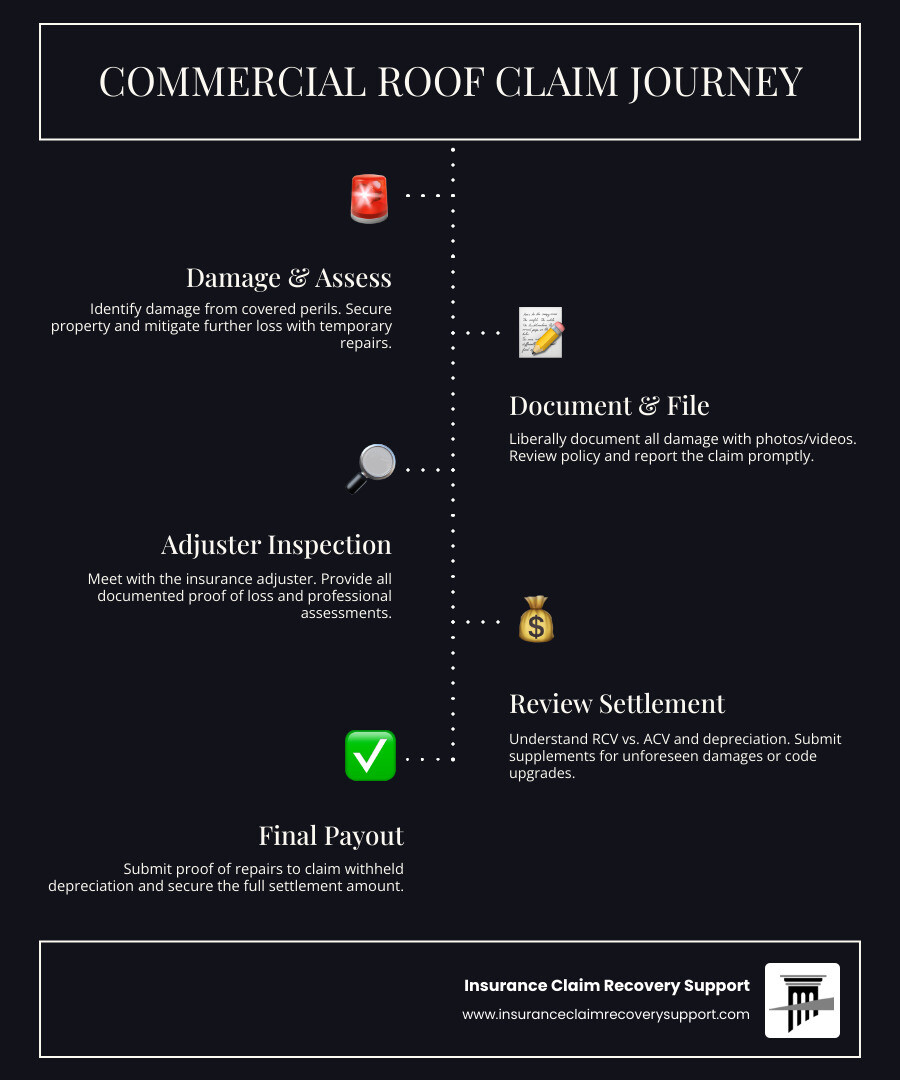
Quick Overview: Key Steps in a Commercial Roof Insurance Claim
- Document the damage immediately with photos, videos, and detailed notes
- Review your policy for coverage limits, exclusions, and deductibles
- Report the claim to your insurance carrier as soon as possible
- Hire a professional (roofing contractor or public adjuster) to assess damage
- Meet with the adjuster and provide all documentation
- Understand the payout structure (RCV vs. ACV, depreciation, recoverable depreciation)
- Submit supplements if initial estimates are insufficient
- Negotiate or appeal if you disagree with the settlement offer—often with support from a public adjuster.
Commercial and multifamily properties are major investments, and finding that your roof has suffered damage can be incredibly frustrating. Unlike residential claims, commercial roof insurance claims involve significantly larger dollar amounts, more complex policies, and higher stakes—including business interruption, tenant pressure, and potential revenue loss.
The insurance adjuster does not have a duty to find damage. Instead, the insurance adjuster is there to look at the damage you have found. This is a critical distinction that many commercial and multifamily property owners and managers don’t understand until it’s too late. You—the policyholder—have the primary responsibility to prove your loss, not the insurance company.
Almost all building-related claims are first valued at their replacement cost value (RCV) amount, but insurance companies typically withhold depreciation and only pay the actual cash value (ACV) upfront. Unclaimed depreciation can total $1 billion or more in a given year, meaning countless policyholders leave money on the table simply because they don’t understand how to recover these withheld funds.
I’m Scott Friedson, CEO of Insurance Claim Recovery Support (ICRS), and over the past 15 years, I’ve successfully settled hundreds of millions of dollars in Commercial Roof Insurance Claims for commercial and multifamily property owners and managers across Texas and beyond. My firm specializes in overturning wrongfully denied claims, negotiating fair settlements, and helping policyholders avoid unnecessary litigation—often increasing claim recoveries by 30% to more than 3,800%.
Fact vs. Myth: Lawsuits vs. Public Adjusters for Commercial Roof Claims
Myth: “If my commercial or multifamily roof claim is underpaid or denied, my only real option is to file a lawsuit.” Fact: For many property damage claims, a licensed public adjuster can often resolve disputes faster, with lower out-of-pocket costs and less disruption than litigation—and without giving up your right to sue later if needed.
Myth: “Using a public adjuster means I’m picking a fight with my insurance company.” Fact: Public adjusters work within the policy and the claim process to professionally document your loss, present the claim, and negotiate on your behalf. Their goal is to reach a fair settlement and help you avoid an adversarial, drawn-out lawsuit whenever possible.
Myth: “A lawsuit is the quickest way to get my building fixed and my tenants satisfied.” Fact: Insurance litigation for large commercial or multifamily losses can take years, involve extensive findy, expert testimony, and appeals, and tie up capital that could be used for repairs. A well-managed claim led by a public adjuster typically resolves in months, not years, allowing repairs to move forward sooner.
Public Adjuster vs. Insurance Lawsuit: What Commercial & Multifamily Owners Should Know
Using a Public Adjuster for a Property Damage Claim
- Focus: Maximizing and documenting your covered loss under the policy.
- Timeline: Usually measured in weeks to several months from filing to final settlement, depending on claim size and complexity.
- Process:
- Site inspection and detailed damage assessment
- Estimating repair or replacement costs (often using the same software carriers use)
- Assembling proof of loss, reports, and supporting documentation
- Negotiating directly with the carrier’s adjusters and examiners
- Submitting supplements when additional damage or costs are identified
- Costs: Typically a contingent fee based on the amount recovered; no hourly billing, depositions, or court costs.
- Control: You keep control of business decisions like phasing repairs around tenants, occupancy, and operations.
Filing an Insurance Lawsuit for Property Damage
- Focus: Proving breach of contract and/or bad faith in court, not simply documenting damage.
- Timeline: Frequently 1-3 years or longer, especially for large commercial or multifamily claims.
- Process:
- Hiring coverage counsel and litigation experts
- Pleadings, findy, depositions, and motion practice
- Possible mediation, trial, and appeals
- Costs: Attorney fees (often contingent, sometimes hybrid), court costs, expert witness fees, and significant staff time from your organization.
- Disruption: Extended uncertainty for budgets, lenders, and tenants; capital planning and major repairs often remain on hold pending outcome.
How a Public Adjuster Helps You Avoid Unnecessary Litigation
For many commercial and multifamily owners and managers, a public adjuster is the missing professional on the claim team. By thoroughly preparing and presenting your claim up front, a public adjuster can:
- Identify and document all compensable damage before the carrier’s inspection.
- Translate complex policy language into a clear strategy for recovery.
- Narrow the disputed issues so that, if litigation ever becomes necessary, it is more focused and better supported.
- Achieve fair settlements that make lawsuits unnecessary in a large percentage of cases.
If negotiation truly stalls or coverage is wrongly denied, your documented, adjuster-prepared file becomes a strong foundation should you and your attorney decide that litigation is the next step.
The Commercial Roof Insurance Claim Process: From Damage to Payout
Navigating a Commercial Roof Insurance Claim can feel daunting, but understanding the process step-by-step empowers commercial and multifamily property owners and managers to protect their investments.
Immediate Actions & Initial Assessment
When your commercial or multifamily property’s roof takes a hit, swift and smart action is crucial. The first moments after finding damage can significantly impact your claim’s success.
What are the most common causes of commercial roof damage?
Commercial roofs are constantly exposed to the elements. Common culprits behind roof damage include:
- Storm Damage: High winds can lift, tear, or dislodge roofing materials, while impact from wind-driven debris can cause punctures and bruising.
- Water Damage: Standing water due to poor drainage, clogged gutters, or faulty flashing can add immense stress to a roof.
- Leaks and Faulty Flashing: Often a result of wear and tear or improper installation, compromised flashing around vents, skylights, or parapet walls allows water to seep into the building.
- Punctures: Can occur from falling debris, foot traffic during maintenance, or installation of new equipment like HVAC units.
What steps should a commercial property owner or manager take immediately after finding roof damage?
- Prioritize Safety: Ensure the area around and within the damaged property is safe for occupants and employees.
- Evaluate the Damage: From a safe vantage point, observe the extent of the damage.
- Mitigate Further Loss: Make temporary repairs to prevent additional damage to your building and its contents.
- Document Temporary Repairs: Take photos or videos of the damage before and after any temporary repairs. Keep all receipts.
- Understand Tarping Limitations: While necessary, temporary tarping is not a permanent solution. Do not undertake permanent repairs until your claim is processed.
For more guidance on securing your property, visit our page on Building Damage.
Effectively Documenting Your Commercial Roof Insurance Claim
Thorough documentation is the backbone of a successful Commercial Roof Insurance Claim. The burden of proof rests with you.

How can property owners and managers effectively document roof damage for an insurance claim?
- Go Liberal with Documentation: Document everything, no matter how small it may seem.
- Visual Evidence is Key:
- Photos: Take numerous high-resolution photos from various angles.
- Videos: A video walkthrough can provide a dynamic view of the damage.
- Detailed Notes: Keep a meticulous log including dates, descriptions, and immediate actions taken.
- Professional Inspection Report: Engage a reputable commercial roofing contractor and consider hiring a public adjuster.
What information should be included when filing an initial insurance claim?
Be prepared to provide:
- Your policy number
- The date of the loss
- A description of the damage
- All detailed documentation you’ve gathered
For a comprehensive checklist, refer to our Large Loss Claim Documentation Lists.
Understanding the Adjuster’s Role and Financials
The insurance adjuster plays a pivotal role in your claim, but it’s crucial to understand their position and how financial aspects are assessed.
How do insurance adjusters assess commercial roof damage claims?
An insurance adjuster will visit your property to inspect the damage. Their primary role is to determine if the damage falls under your policy’s coverage and to estimate the cost of repairs or replacement. Crucially, the adjuster is there to look at the damage you have found. They do not have a duty to actively seek out every piece of damage.
FAQ: Public Adjusters and Commercial Roof Claims
Q: When should a commercial or multifamily owner involve a public adjuster? A: Consider hiring a public adjuster when the damage is extensive, the policy language is complex, the carrier’s estimate seems low, or you don’t have the internal bandwidth to manage a large claim.
Q: Does hiring a public adjuster mean I can’t use an attorney later? A: No. A public adjuster manages the claim and negotiation phase. If the insurer still refuses to act reasonably, you can later engage coverage counsel.
Q: Why not just go straight to a lawsuit if I’m unhappy with the offer? A: Lawsuits are time-consuming, expensive, and disruptive. A public adjuster focuses on building and negotiating the strongest possible claim first, which often results in a fair settlement without court involvement.
What are the differences between Replacement Cost Value (RCV) and Actual Cash Value (ACV)?
| Feature | Replacement Cost Value (RCV) | Actual Cash Value (ACV) |
|---|---|---|
| Definition | Cost to replace damaged property with new materials of similar kind and quality, without deduction for depreciation. | Value of damaged property at time of loss (replacement cost minus depreciation). |
| How It Works | You’ll eventually be reimbursed for full cost of repairs or replacement, subject to policy limits. | Insurance company issues initial payment for ACV of damaged property. |
| Depreciation | Not deducted from final settlement if repairs are completed per policy terms. | Deducted based on age, wear and tear, and obsolescence. |
| Recoverable Depreciation | Portion of depreciation you can recover after completing repairs and submitting invoices. | N/A – With ACV-only policy, you only receive depreciated value. |
For more details on these financial terms, see our guide on Loss Adjusting Services.