When Flood Damage Strikes Your Commercial or Multifamily Property, Here’s What to Do First
Flood damage is the single most common and costly natural disaster facing commercial property owners, multifamily operators, and real estate investors in the United States — and the window to protect your asset, your tenants, and your insurance recovery is measured in hours, not days.
Here’s a quick-reference guide to your most urgent priorities:
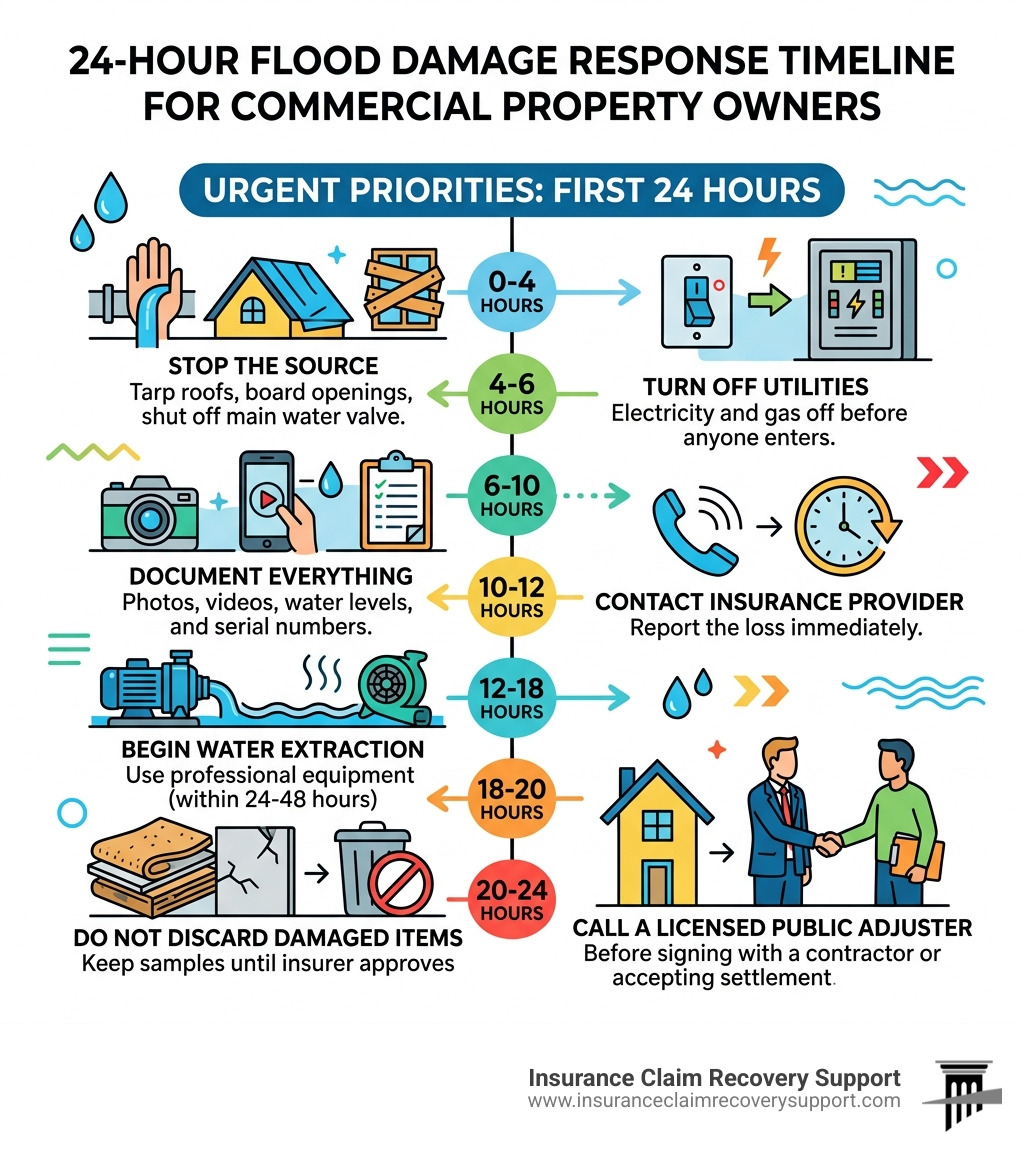
🚨 Your First 24-Hour Flood Response Checklist
- Stop the source — Tarp roofs, board openings, shut off the main water valve
- Turn off utilities — Electricity and gas off before anyone enters
- Document everything — Photos, videos, water levels, and serial numbers before cleanup begins
- Contact your insurance provider — Report the loss immediately to start your claim clock
- Begin water extraction — Use professional sub-pumps and air movers within 24-48 hours to prevent mold
- Do not discard damaged items — Keep materials and samples until your insurer approves disposal
- Call a licensed public adjuster — Before signing anything with a contractor or accepting any settlement
Floods don’t just damage buildings — they disrupt tenants, halt revenue, trigger lender compliance issues, and open the door to drawn-out insurance disputes that can cost you far more than the flood itself. The difference between a fair settlement and a severely underpaid claim often comes down to what you do in the first 48 hours and who is in your corner when the adjuster shows up.
The stakes are real: one inch of floodwater in a 1,000 square foot space can cause more than $10,600 in damage. A single foot of water pushes that figure past $27,000 — and that’s before accounting for business interruption, code upgrades, or mold remediation.
This guide walks you through every phase of flood damage recovery — from understanding what your policy actually covers, to documenting your loss, to avoiding the litigation trap that drains time and money from commercial policyholders every year.
I’m Scott Friedson, CEO of Insurance Claim Recovery Support (ICRS) and a multi-state licensed public adjuster with over 15 years of experience resolving flood damage claims for commercial and multifamily property owners across the country. Over the course of 500+ large-loss claims, I’ve seen how the right recovery strategy — and the right advocate — can mean the difference between a denied claim and a settlement that fully restores your property.
Explore more about flood damage:
Navigating the Complexities of Flood Damage and Insurance
Navigating the aftermath of a flood is often more complicated than the physical cleanup itself. For property managers in Austin, Houston, or Dallas, the first hurdle is often realizing that your standard commercial property policy likely excludes flood damage entirely.
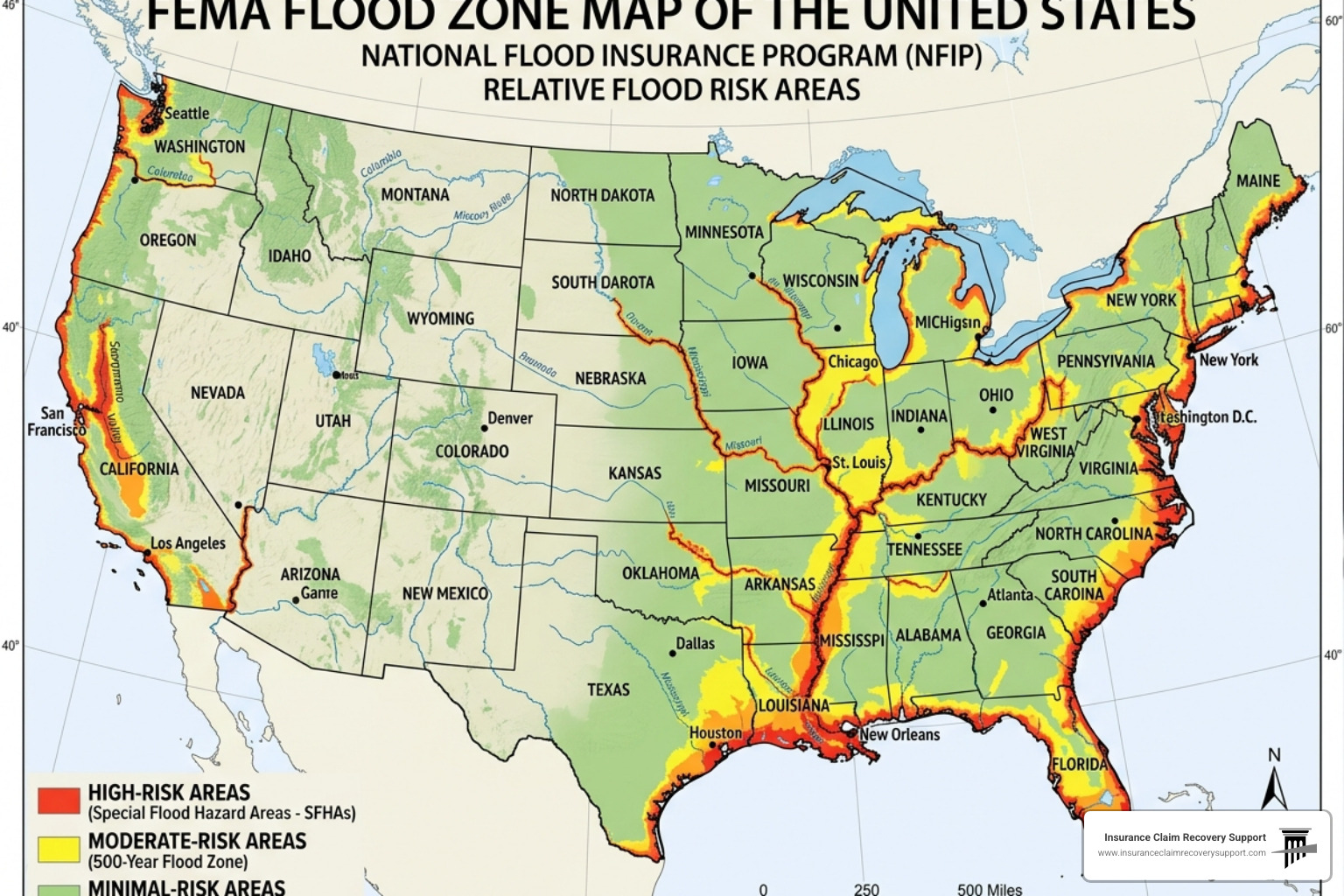
Most people are surprised to learn that the National Flood Insurance Program (NFIP) has a very specific, legal definition of a “flood.” According to FEMA, a flood is a general and temporary condition of partial or complete inundation of two or more acres of normally dry land area OR of two or more properties (at least one of which is your property).
This definition is critical. If your building is the only one affected by rising water, your insurer might argue it doesn’t meet the NFIP criteria. Furthermore, there is a mandatory 30-day waiting period for new flood insurance policies. You cannot wait until a hurricane is brewing in the Gulf to buy coverage.
In states like Texas, where we frequently deal with everything from coastal storm surges to inland flash flooding, understanding these nuances is vital. Whether it is a Texas Flood caused by a stalled tropical system or rapid snowmelt, the water must generally come from the “ground up” to be considered a flood. This includes mudflows and surface water runoff.
Flood Damage vs. Water Damage: Understanding the NFIP Definition
One of the most common reasons for claim denials is the confusion between “water damage” and flood damage. While they both involve H2O, insurance companies treat them as two entirely different animals.
| Feature | Water Damage (Standard Policy) | Flood Damage (NFIP/Private Flood) |
|---|---|---|
| Source | Internal (Pipes, HVAC, Roof Leak) | External (Rising rivers, Surface runoff) |
| Scope | Usually isolated to one property | 2+ acres or 2+ properties |
| Direction | Top-down or internal | Ground-up |
| Coverage | Included in most commercial policies | Requires separate Flood Policy |
For instance, a pipe burst in a multifamily complex in San Antonio is typically a water damage claim. However, if a massive rainstorm causes a nearby creek to overflow and inundate the first floor of that same complex, you are looking at a flood claim.
We also see many issues during a winter storm insurance claim where frozen pipes burst. If the water stays inside the building, it’s water damage. If the water flows outside, mixes with snowmelt, and then re-enters the building from the ground, the lines get blurry—and that’s exactly where insurance companies try to save money by denying your claim.
Immediate Health Risks and Mold Growth After Flooding
The clock is your biggest enemy. Within just 24 to 48 hours of water intrusion, mold can begin to colonize porous materials like drywall, insulation, and carpeting. This isn’t just an aesthetic issue; it’s a major health hazard.
According to scientific research on respiratory risks from floodwater, floodwaters are often a “toxic soup” containing raw sewage, industrial chemicals, oil, and bacteria. Standing water is a breeding ground for microorganisms that can cause long-term lung disease and severe allergic reactions.
When entering a flooded property in Fort Worth or Houston, we always insist on proper Personal Protective Equipment (PPE). This includes:
- N95 Respirators (NIOSH-certified) to prevent inhaling mold spores.
- Goggles and heavy-duty gloves.
- Sturdy boots to protect against sharp debris hidden under murky water.
A major pitfall for commercial owners is the mold removal coverage limit. Most NFIP policies have a strict $5,000 limit on mold damage. If you don’t act fast to dry the building out, your remediation costs could easily soar into the six-figure range, leaving you to foot the bill.
Additionally, never use fuel-burning devices like portable generators or grills indoors during the cleanup. Carbon monoxide poisoning is a leading cause of death following major flood events.
Documenting Your Flood Damage Claim for Maximum Recovery
Your settlement is only as good as your documentation. Before a single gallon of water is pumped out, you must act like a forensic investigator.
We recommend the following steps for a successful flood insurance claim:
- Capture the “Water Line”: Take photos showing exactly how high the water rose on the walls (both inside and out).
- Wide-Angle and Close-Ups: Photograph every room from multiple angles. Get close-ups of damaged machinery, electronics, and structural cracks.
- Serial Numbers: Document the serial numbers of all major appliances, HVAC units, and industrial equipment.
- Keep Samples: Do not throw away that soaked carpet just yet. Cut out a 12×12 inch square to prove the quality and type of material to the adjuster.
- Save Every Receipt: From the plywood used to board up windows to the fuel for the generators, every penny spent on mitigation should be tracked.
The insurance company’s adjuster is looking for reasons to depreciate your loss. Having clear, timestamped evidence makes it much harder for them to underpay you.
Professional Recovery Strategies and Avoiding Litigation
The financial impact of flood damage is staggering. Statistics show that the average flood insurance claim payment between 2020 and 2024 was $82,614. For a large commercial asset or a multifamily complex in a city like Austin or Lubbock, that number can be significantly higher.
When you’re dealing with a loss of this magnitude, a “DIY” approach to the insurance claim is a recipe for disaster. Professional recovery requires a strategic balance of rapid mitigation and expert policy interpretation. Our Texas Flood 2025 Guide emphasizes that for property managers and HOAs, the goal is to stabilize the asset and maximize the recovery without getting bogged down in years of court battles.
Step-by-Step Cleanup and Mitigation Guidelines
Once the water recedes and it is safe to enter, follow these steps to protect your property’s value:
- Utility Safety: Ensure a professional electrician clears the building before turning the power back on. Submerged outlets and wiring are extremely dangerous.
- Water Extraction: Hire a professional mitigation firm to use industrial-grade sub-pumps. Household shop-vacs are not enough for commercial-scale flooding.
- Discard vs. Clean:
- Discard: Porous materials like drywall (cut at least 12 inches above the water line), insulation, mattresses, and padded furniture.
- Clean: Non-porous surfaces like metal, glass, and certain hard plastics can often be disinfected with soap and water.
- Structural Drying: Use high-capacity air movers and dehumidifiers. The goal is to get the relative humidity down quickly to stop mold in its tracks.
- Document the “Openings”: If you are in a coastal area like Florida or Houston, ensure you document any wind-created openings that allowed water in, as this may trigger different coverage parts in your Florida insurance claim.
Fact vs. Myth: The Reality of Flood Insurance Claims
There is a lot of misinformation floating around after a disaster. Let’s clear up a few things based on scientific research on flood cleanup safety:
- Myth: “I don’t live in a flood zone, so I don’t need to worry.”
- Fact: Roughly 25% of all flood claims come from areas outside of high-risk zones. If it rains, it can flood.
- Myth: “My basement is fully covered.”
- Fact: NFIP coverage for basements is very limited. It generally only covers “permanently installed” items like water heaters or furnaces. Finished basement walls and personal contents are often excluded.
- Myth: “I have to wait for the adjuster to arrive before I start cleaning.”
- Fact: You have a policy obligation to “mitigate” the damage. If you wait five days for an adjuster and mold takes over, the insurer may deny the mold portion of the claim because you failed to act.
- Myth: “I can’t get any money until the claim is finished.”
- Fact: You can often request an advance payment. FEMA allows for up to $5,000 without documentation or up to $20,000 with a signed authorization in major events. These funds are later deducted from your final settlement.
Pro Tip: Always verify your adjuster’s identity. A legitimate NFIP adjuster will carry a Flood Control Number (FCN) card. Beware of contractor scams that require large upfront payments before work begins.
Why Commercial Policyholders Choose Public Adjusters Over Lawsuits
When a claim is denied or severely underpaid, many commercial building owners think their only option is to sue. However, litigation is slow, expensive, and often unnecessary.
At Insurance Claim Recovery Support (ICRS), we offer a different path. As licensed public insurance adjusters, we represent you, the policyholder—never the insurance company. We specialize in large-loss commercial and multifamily claims, from hospitality assets in Lakeway to industrial facilities in Fort Worth.
Why choose a Public Adjuster over a lawyer?
- Speed: Lawsuits can take years. We aim to resolve claims in months by using the “Appraisal” process or direct negotiation.
- Success Rate: We maintain a 90% settlement success rate without the need for unnecessary litigation.
- Expertise: We don’t just know the law; we know building codes, restoration costs, and the “carrier roadmap.” We speak the insurance company’s language.
- No Upfront Cost: We work on a contingency basis. If you don’t get paid, we don’t get paid.
Whether you are an apartment investor in San Angelo or a professional property manager in San Antonio, you don’t have to handle your flood damage claim alone. We advocate for you to ensure you receive every penny you are owed under your policy.
For more information on how we can help you navigate the complexities of your recovery, explore our flood damage recovery services.
Frequently Asked Questions (FAQ)
Q: How quickly does mold grow after a flood? A: Mold can start growing within 24 to 48 hours. Rapid drying is essential to prevent a total loss of interior finishes.
Q: Does my standard homeowners or commercial policy cover flood? A: Almost never. You typically need a separate policy through the NFIP or a private flood insurer.
Q: What is “Increased Cost of Compliance” (ICC) coverage? A: If your building is substantially damaged, ICC provides up to $30,000 to help cover the cost of bringing the structure up to current local flood zone building codes.
Q: Can I appeal a denied flood claim? A: Yes. You can appeal to FEMA, but you must provide new, supporting documentation to prove the loss. This is where a public adjuster’s expertise is invaluable.
Q: What are the most common mistakes in flood recovery? A: Failing to document the damage before cleanup, discarding evidence too early, and hiring “storm chaser” contractors who aren’t licensed for large-loss commercial work.
Recovering from flood damage is a marathon, not a sprint. By taking the right steps in the first 24 hours and hiring professional representation, you can protect your investment and get your business back on its feet. If you’re facing a complex claim in Texas or any of the states we serve, contact us today to discuss your options.
For more on policy terms and documenting a flood loss, read the ICRS flood damage claim guidance. Flood coverage depends on the policy and cause of loss.