Texas Hail Is No Small Storm — Here’s What Commercial Property Owners Need to Know First
hail damage reports texas property owners file every storm season tell a striking story: this state gets hit harder, more often, and with larger hailstones than almost anywhere else in the country. If you own or manage a commercial building, apartment complex, warehouse, or multifamily portfolio in Texas, understanding how hail damage gets reported — and what to do with that information — can be the difference between a fair settlement and a prolonged insurance nightmare.
Here’s a quick breakdown of what you need to know right now:
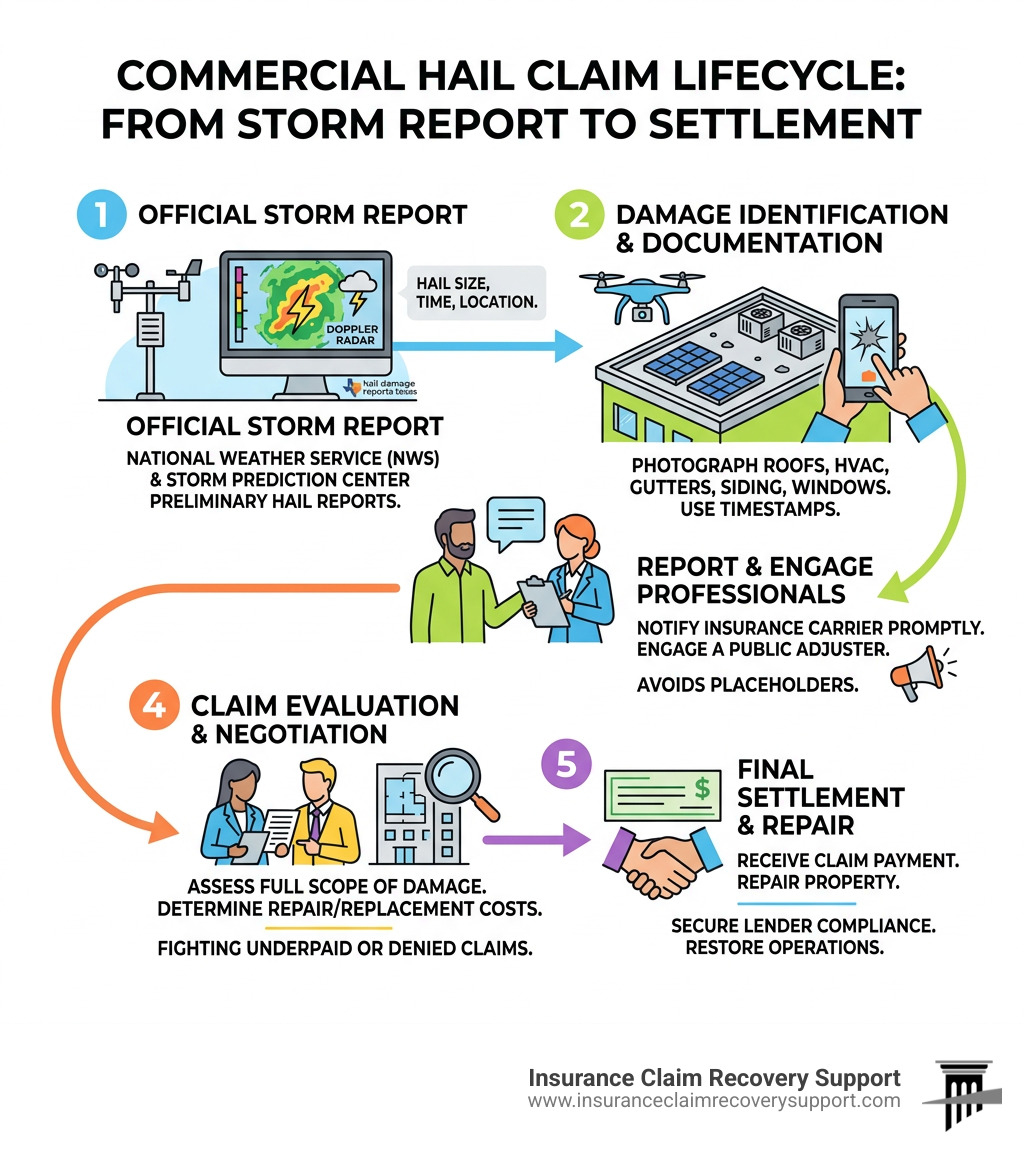
How to find and report hail damage in Texas:
- Check official storm reports — The National Weather Service (NWS) and Storm Prediction Center publish preliminary hail reports by county, including hail size, time, and location.
- Cross-reference radar data — Doppler radar detections are logged by services like HailTrace and can confirm whether hail passed over your specific property.
- Document on-the-ground damage immediately — Photograph all affected surfaces: roofs, HVAC units, gutters, siding, and windows. Timestamps matter.
- Report to your insurance carrier — Notify your insurer promptly. Most commercial policies have strict deadlines for reporting storm damage.
- Engage a public adjuster before filing — A licensed public adjuster can assess the full scope of damage and help you avoid an underpaid or denied claim.
Texas is no stranger to catastrophic hail events. On a single day in April 2025, Floyd County recorded hailstones measuring up to 5.20 inches in diameter — confirmed with calipers. In the Houston metro area alone, trained spotters filed 96 on-the-ground hail reports in just 12 months, with Doppler radar detecting hail cores on 244 separate occasions. Commercial roofs, HVAC systems, and building envelopes across the state take a beating that isn’t always visible from the ground — and what you can’t see can absolutely wreck your claim.
For commercial and multifamily property owners, the stakes go beyond shingles. A poorly documented or underpaid claim can mean delayed repairs, tenant disputes, lender compliance issues, and lost revenue that compounds every week the building sits unrestored.
I’m Scott Friedson, a multi-state licensed public adjuster and CEO of Insurance Claim Recovery Support (ICRS), with over 15 years of experience resolving large-loss commercial property claims — including hundreds of hail damage reports texas storm seasons have generated across the state. Over 500+ claims totaling more than $250 million in settled losses, I’ve seen how the reporting and documentation process shapes every outcome that follows.
Quick hail damage reports texas definitions:
Navigating Hail Damage Reports in Texas for Commercial Properties
When a massive storm front rolls through the I-35 corridor or the Gulf Coast, the data starts pouring in. But for a commercial property manager in Dallas or an apartment investor in Houston, a general news headline isn’t enough to prove a loss to an insurance carrier. We need granular data.
Official hail damage reports texas are compiled from a variety of sophisticated sources. The National Weather Service (NWS) utilizes Doppler radar to identify “hail cores”—areas within a thunderstorm where frozen precipitation is most intense. Understanding the mechanics of these storms is vital; scientific research on hail formation and impact energy shows how velocity and mass combine to compromise commercial structures. In the Houston area, for instance, Doppler radar has detected hail on 244 occasions historically, providing a digital footprint of where the most significant risks lie.
However, radar is only part of the puzzle. Ground-truth verification comes from the mPING (Meteorological Phenomena Identification Near the Ground) app, social media crowdsourcing, and NWS-trained spotters. This multi-layered approach helps verify that the “ping pong ball” sized hail detected by radar actually hit the ground and caused the Hail Damage reported by local businesses.
Understanding Official Hail Damage Reports in Texas
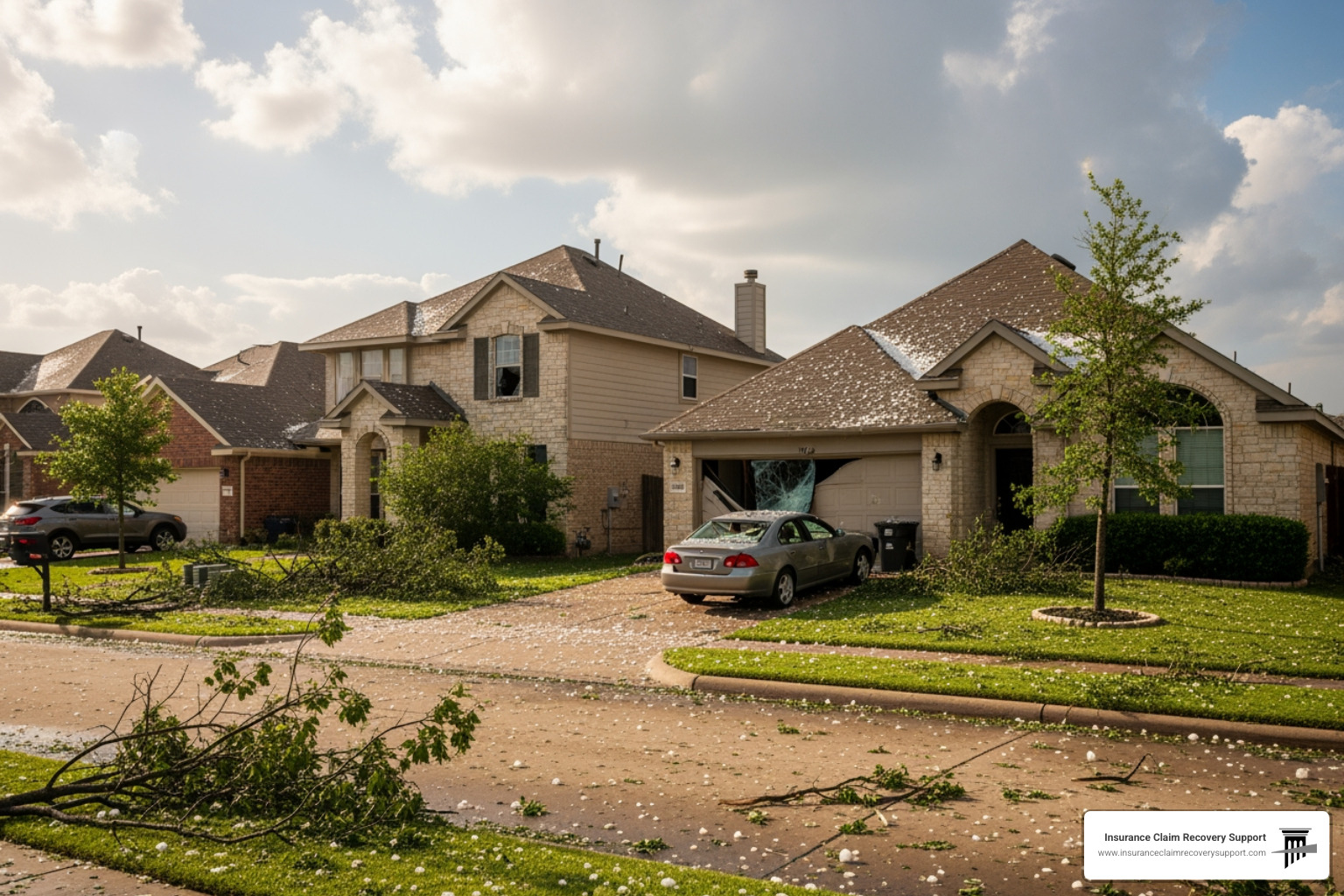
The scale of Texas hail is often hard to wrap your head around until you see the measurements. Recent data from April 24, 2025, showed 76 hail reports across 8 states, but Texas stole the spotlight with “giant” hail. In Floyd County, hailstones were measured at a staggering 5.20 inches using precision calipers. To put that in perspective, that is larger than a grapefruit and falling at terminal velocity.
In the Houston metro, the data is equally sobering. Over a recent 12-month period, there were 96 on-the-ground reports from trained spotters. On May 28, 2024, Houston experienced one of its top recent hail dates, with widespread reports of golf ball (1.75″) and ping pong ball (1.50″) hail.
These reports are gathered and verified through:
- mPING: Automated reports from mobile users providing real-time location data.
- Social Media: Photos of hailstones next to rulers or common objects (like the 4.50″ stones measured in Floyd, TX).
- Emergency Managers: Official accounts of damage, such as the Moore County incidents where 2.50″ hail blew out windows in patrol units and destroyed windshields.
- Radar Analysis: NWS offices (like those in League City or Lubbock) using specific algorithms to estimate hail size based on reflectivity.
Identifying Damage Beyond the Surface
For a multifamily complex or an industrial warehouse, hail damage is rarely just about “dents.” Large-scale properties have complex building envelopes that react differently to impact energy. While a residential roof might show missing granules, a commercial roof membrane can suffer “star fractures” or delamination that isn’t visible without a professional forensic inspection.
Commonly affected areas include:
- Roof Membranes: TPO, EPDM, and PVC roofs can suffer punctures or bruising that leads to Hail Damage Roof Repair needs months later when leaks finally manifest.
- HVAC Fins: Hail can flatten the delicate aluminum fins on rooftop AC units, restricting airflow and leading to premature equipment failure or “slugging” the compressor.
- Commercial Siding and EIFS: Large hail can crack Exterior Insulation and Finish Systems (EIFS), allowing moisture to penetrate the building’s substrate.
- Windows and Skylights: In Moore County, 2.75″ hail was powerful enough to shatter reinforced glass. For a high-rise or retail center, this creates immediate safety hazards and business interruption.
Fact vs. Myth: Filing Based on Hail Damage Reports in Texas
There is a lot of misinformation circulating after a storm. Many property owners wait for a “catastrophe” declaration or a certain hail size before they consider a claim. This is a mistake.
Myth: Hail must be at least 1 inch (quarter-sized) to cause damage. Fact: While 1 inch is the NWS threshold for a “severe” thunderstorm, high-wind driven hail as small as 0.75 inches can damage aged roof membranes or clog drainage systems with debris, leading to interior water damage.
Myth: If the roof isn’t leaking, there is no damage. Fact: Hail damage is cumulative. An impact might not cause a leak today, but it compromises the integrity of the material, significantly shortening its lifespan. Hail Damage Covered by Insurance includes the loss of functional life, not just active leaks.
| Material Type | Commercial Impact | Residential Impact |
|---|---|---|
| Roofing | Membrane bruising/fractures, seam failure | Shingle granule loss, mat bruising |
| HVAC | Fin crushing, coil damage, housing dents | Minor fin damage, unit aesthetic dents |
| Windows | Large pane cracking, frame seal failure | Screen tearing, small pane breakage |
| Gutters | Box gutter deformation, drainage clogs | Dents, downspout blockage |
Securing Your Settlement: Public Adjuster vs. Litigation
When the hail damage reports texas confirms your property was in the strike zone, the clock starts ticking on your policyholder duties. You are required to mitigate further damage and provide a prompt notice of loss. However, how you approach the “proof of loss” stage determines whether you’ll be fighting your carrier in court for the next three years.
As a public insurance adjusting firm, we at Insurance Claim Recovery Support (ICRS) focus on one goal: maximizing your settlement while avoiding the need for a lawsuit. Litigation is the “nuclear option”—it’s expensive, exhausting, and often unnecessary if the claim is handled correctly from day one.
The High Cost of Insurance Litigation
Many property owners are quick to call a lawyer when a claim is denied or underpaid. While there is a place for legal action, the downsides are significant. Litigation often involves:
- Multi-year delays: It is not uncommon for insurance lawsuits in Texas to drag on for 24 to 36 months.
- Hefty Legal Fees: Most attorneys take 33% to 40% of the settlement, plus “costs” for expert witnesses and filing.
- Court Uncertainty: You are putting your recovery in the hands of a jury or judge who may not understand the nuances of commercial building science.
Consider the 2 Billion in Insured Losses from 9 Tornadoes in Dallas TX. According to scientific research on the economic impact of severe storms, Texas frequently leads the nation in weather-related property losses. The sheer volume of claims from such events often leads to “assembly line” adjusting by carriers, resulting in massive underpayments. Jumping straight to a lawsuit adds friction to an already stressed system.
Why Commercial Owners Choose Public Adjusters
We advocate for the policyholder—never the insurance company. Our role is to act as your professional representative, handling the heavy lifting of the Hail Insurance Claim Process.
Why choose a public adjuster over an attorney or going it alone?
- Expert Documentation: We don’t just say there is damage; we prove it. We use thermal imaging, moisture meters, and forensic roof analysis to create a “bulletproof” claim file.
- Specialized Knowledge: Commercial and multifamily properties have unique needs. Assessing a 100,000-square-foot warehouse is vastly different from a single-family home. We understand industrial materials and Hail Claims complexities.
- Maximizing Settlements: Our 90% settlement success rate is built on professional negotiation. We speak the carrier’s language (Xactimate, policy endorsements, and Texas insurance code) to ensure you get every penny you are owed under the contract.
- Reducing Delays: By providing the carrier with a complete, professionally organized claim package, we remove their excuses for “further investigation” or “lack of evidence.”
Conclusion: Your Path to Recovery
Reporting your Texas hail damage doesn’t have to be a battle. By staying informed with the latest hail damage reports texas provides and acting quickly to document your loss, you put your property in the best position for a full recovery.
At Insurance Claim Recovery Support (ICRS), we specialize in the large-loss claims that keep property managers and investors up at night. Whether you are dealing with the aftermath of a storm in Austin, Dallas, Houston, or San Antonio, our team is ready to step in as your advocate. We handle the technical details, the carrier negotiations, and the administrative headaches so you can focus on running your business.
Don’t let a “no” from an insurance adjuster be the final word. If your commercial or multifamily property has been hit by hail, reach out for a professional second opinion. More info about hail storm damage insurance claims is just a click away. Let us help you settle your claim fairly, quickly, and without the need for a courtroom.
About the Author: Scott Friedson is the CEO of Insurance Claim Recovery Support (ICRS), a leading public adjusting firm dedicated to representing commercial policyholders. With a focus on integrity and results, Scott and his team have settled over $250M in losses, ensuring that Texas property owners aren’t left out in the cold after a storm.