Why Property Owners Need Their Own Experts in Complex Insurance Claims
When a significant property loss occurs, most property owners expect the insurance claim process to be straightforward. But in reality, many quickly find themselves navigating a complex system filled with technical language, evolving requirements, and competing interpretations of damage and coverage.
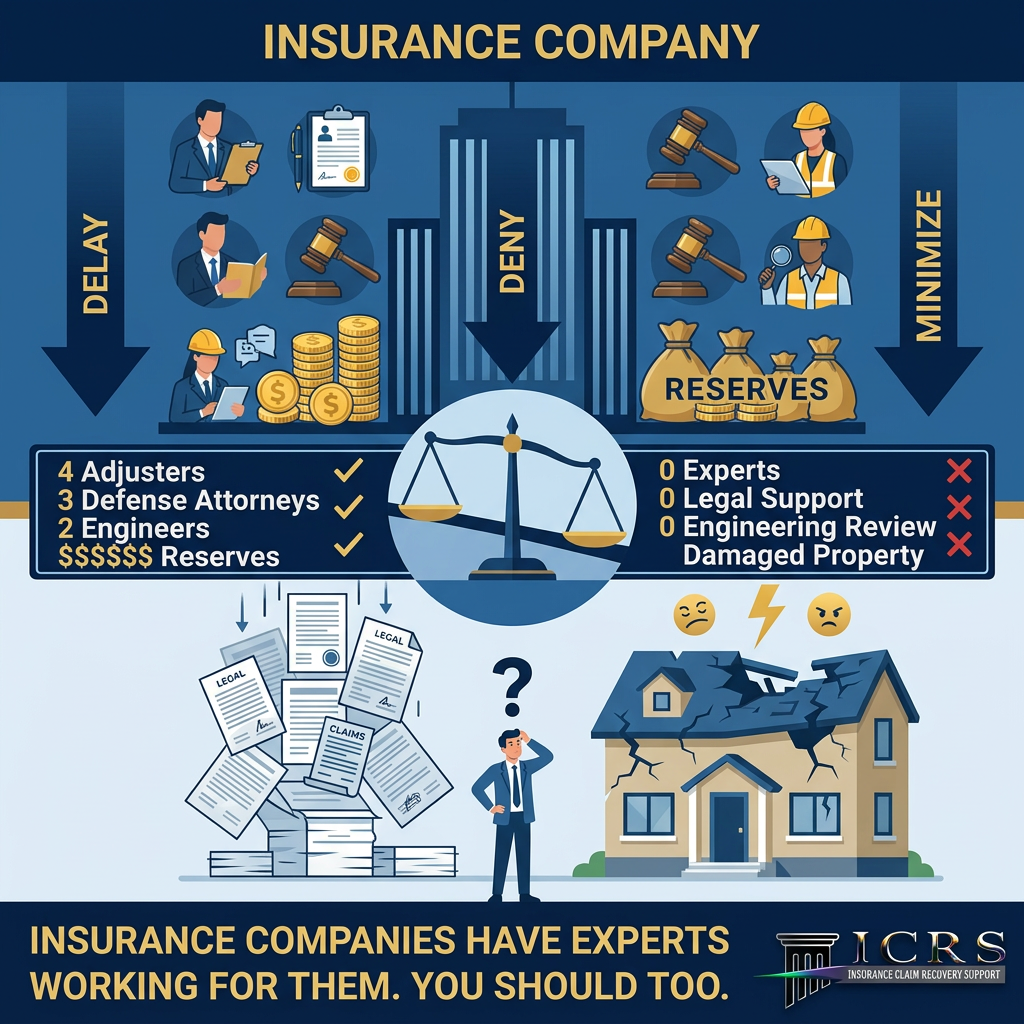
Insurance companies activate teams of adjusters, engineers, consultants, and legal resources trained to evaluate claims in a way that protects their financial exposure.
That’s why the principle is simple:
Insurance companies have experts working for them. You should too™.

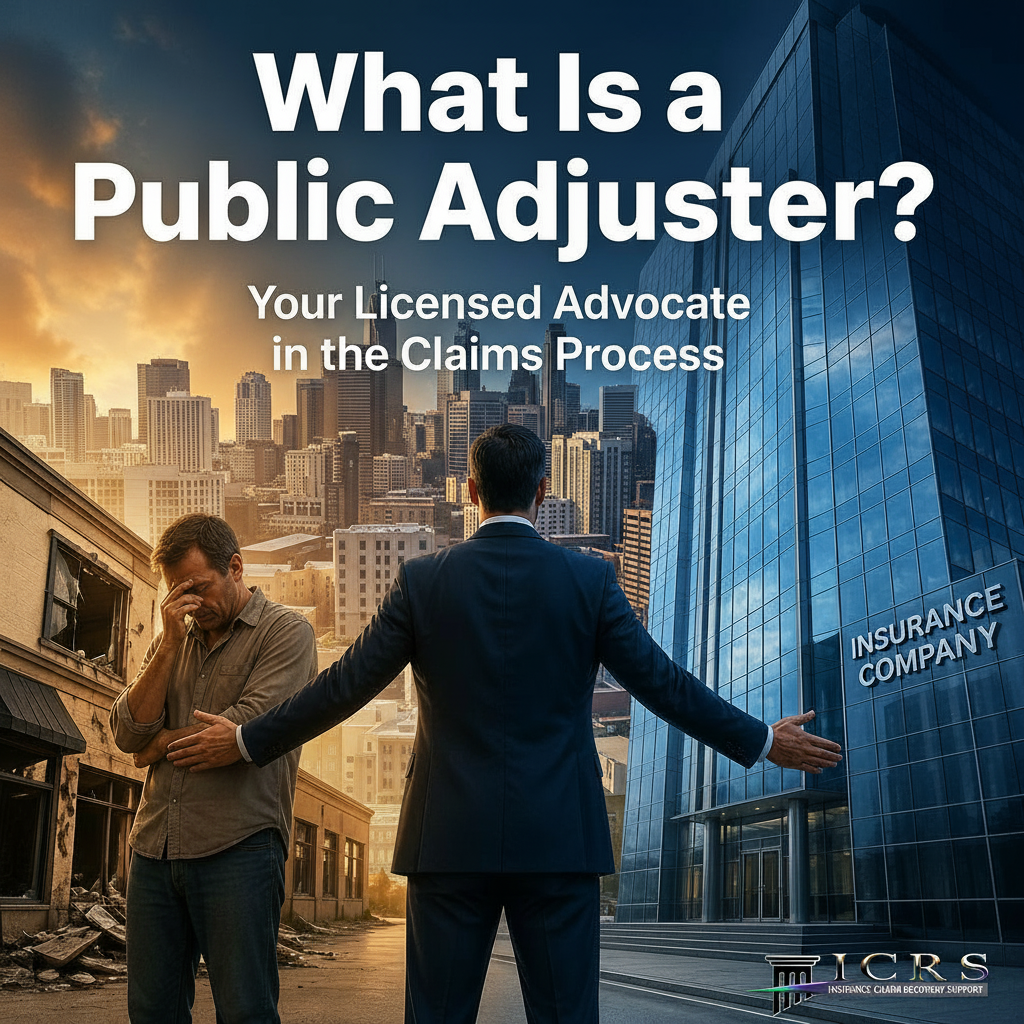
What Is a Public Adjuster?
A public adjuster is a licensed professional who represents policyholders—not insurance companies—in the preparation, documentation, and negotiation of property insurance claims.
If you’re new to the concept, you can start with a more detailed overview here:
www.WhatIsAPublicAdjuster.com
What Does a Public Adjuster Do?
A public adjuster helps property owners:
- Interpret complex policy language
- Document and support damages
- Prepare detailed claim submissions
- Respond to insurance company requests
- Negotiate fair settlements
For larger losses, this process often involves coordinating engineers, contractors, and financial experts to properly support the claim.
What Does a Public Adjuster Do in Large Claims?
While all insurance claims require documentation and negotiation, large-loss property claims operate at a completely different level of complexity.
In these situations, a public adjuster is not just helping with paperwork—they are leading the entire claim strategy.
Large-loss claims often involve commercial properties, multifamily communities, or high-value buildings where the financial exposure is significant. Because of this, insurance companies typically assign experienced adjusters, engineers, consultants, and legal resources to evaluate the claim.
To effectively respond, a public adjuster takes on a much more comprehensive role.
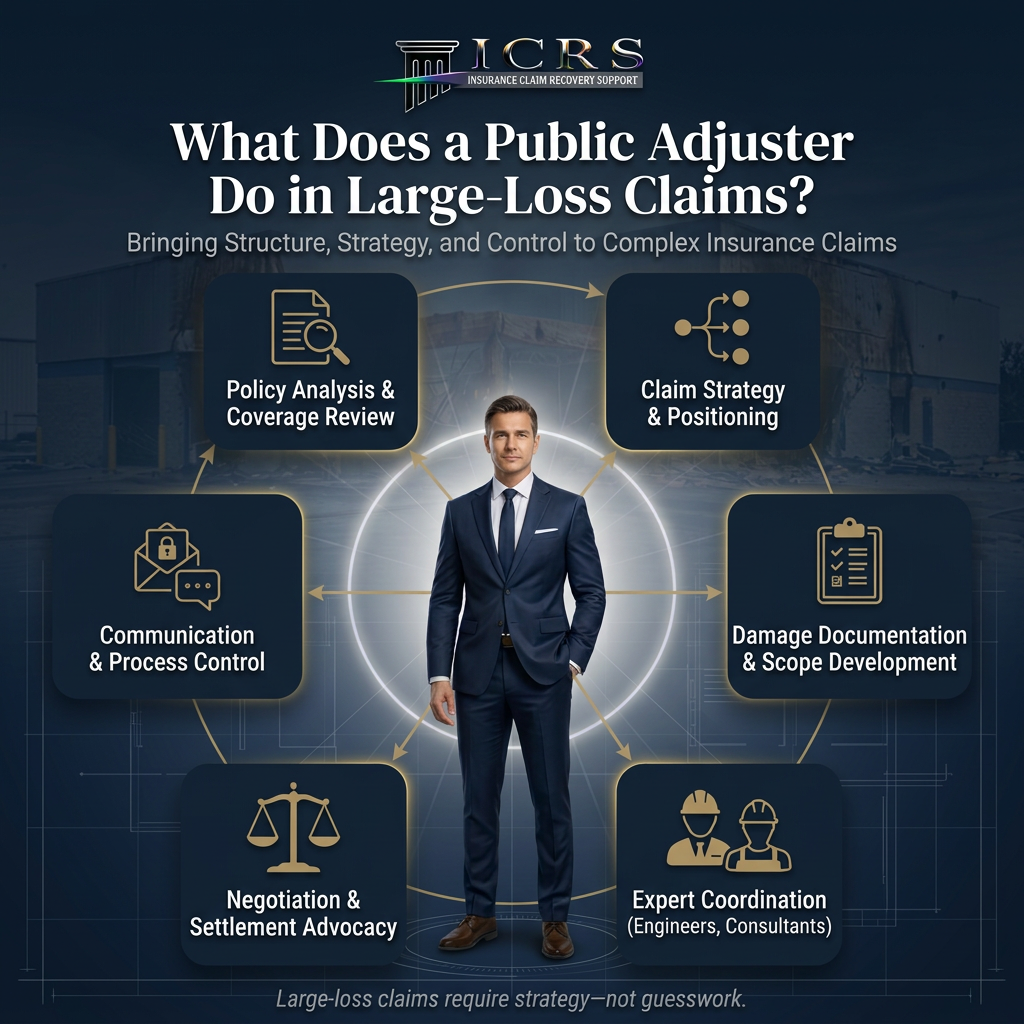
In Large Claims, a Public Adjuster Will:
1. Analyze Complex Policy Coverage
Commercial property policies often include multiple layers of coverage, endorsements, exclusions, and conditions.
A public adjuster:
- Identifies all applicable coverage
- Evaluates exclusions and limitations
- Ensures the insurance company properly applies the policy
2. Build a Comprehensive Claim Strategy
Large-loss claims are not handled piece-by-piece—they must be presented as a complete, evidence-backed case.
This includes:
- Structuring the claim for maximum clarity
- Anticipating potential disputes
- Aligning documentation with policy requirements
3. Coordinate Experts and Technical Evaluations
Unlike smaller claims, large losses often require:
- Engineers
- Roofing consultants
- Building experts
- Forensic accountants (for business interruption)
A public adjuster helps coordinate these professionals to ensure the claim is fully supported.
4. Document the Full Scope of Damage
Insurance company estimates often focus on visible or immediate damage.
A public adjuster works to identify:
- Hidden or progressive damage
- Code upgrade requirements
- System-wide impacts (roofing, structural, mechanical)
- Long-term repair considerations
5. Prepare Detailed, Defensible Claim Submissions
The burden of proof is on the policyholder.
A public adjuster:
- Prepares detailed estimates and documentation
- Organizes evidence clearly
- Responds to insurer requests strategically
6. Manage Communication and Control the Process
Large-loss claims can involve ongoing communication, inspections, and shifting requirements.
A public adjuster:
- Handles communication with the insurer
- Prevents unnecessary delays
- Keeps the claim moving forward
7. Negotiate From a Position of Strength
Because the claim is fully documented and strategically prepared, the public adjuster can:
- Challenge low estimates
- Address coverage disputes
- Push for a fair and timely settlement
Why This Matters in Large-Loss Claims
In smaller claims, mistakes can be inconvenient.
In large-loss claims, mistakes can be financially significant.
- Missed damage = underpayment
- Misinterpreted policy = denied coverage
- Weak documentation = prolonged delays
This is why large-loss claims require more than guidance—they require full professional representation.
Connecting This to Your Situation
If your claim involves:
- Commercial or multifamily property
- Significant structural or system damage
- Business interruption losses
- Disputed or delayed payments
Then your claim likely falls into the category where this level of expertise is critical.
How the Insurance Claim Process Works
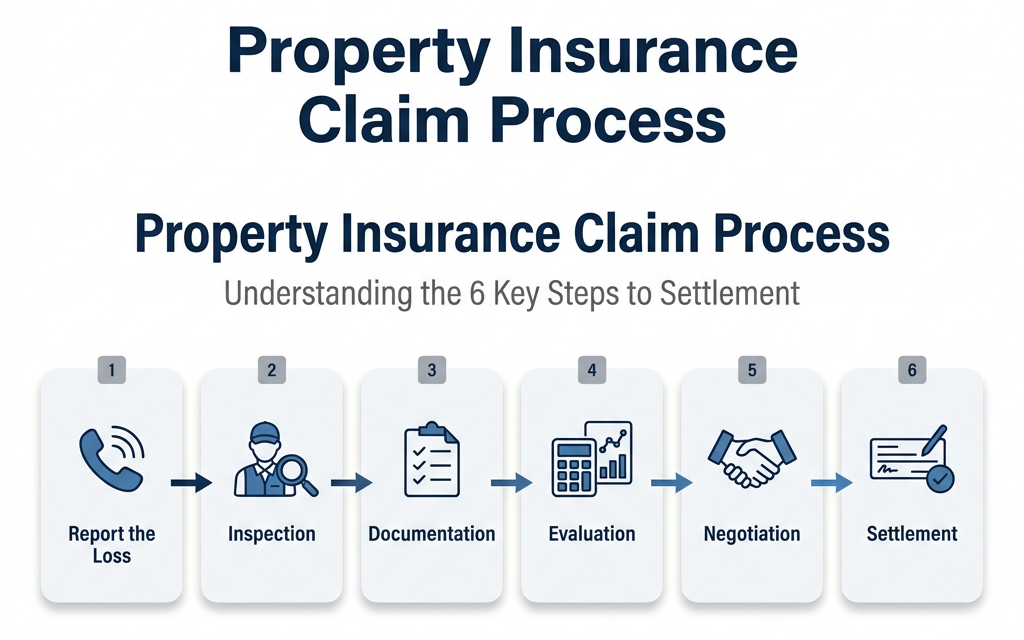
This process becomes significantly more complex in large-loss claims—especially during documentation, evaluation, and negotiation.
Most property insurance claims follow these stages:
- Reporting the loss
- Inspection by the insurance company
- Documentation and claim preparation
- Evaluation of damages and coverage
- Negotiation
- Settlement or dispute resolution
For a deeper breakdown, refer to our Insurance Claim Bible:
Public Adjuster vs Insurance Adjuster
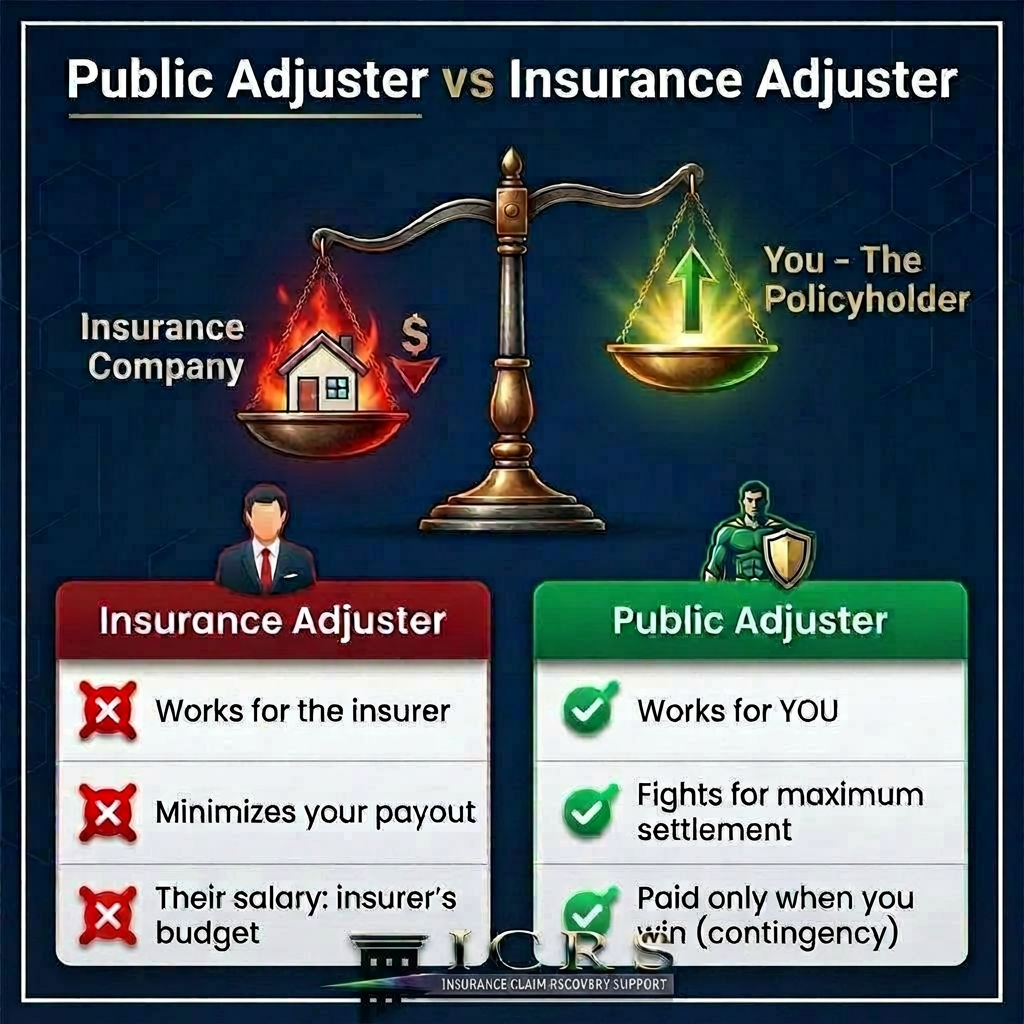
| Adjuster Type | Employer/Loyalty | Primary Role | Payment Structure |
|---|---|---|---|
| Company Adjuster | Insurance Company | Investigates, assesses damage, determines coverage for the insurer | Salary/Benefits from insurer |
| Independent Adjuster | Insurance Company (contracted) | Investigates, assesses damage for the insurer, often for specific expertise or during high demand | Paid by insurer on a per-claim or hourly basis |
| Public Adjuster | Policyholder | Investigates, assesses damage, interprets policy, negotiates for the policyholder | Percentage of final settlement (contingency fee) |
This distinction is critical.
For an independent overview of the duties and loyalties of adjusters, see the U.S. Department of Labor CareerOneStop resource: Claims Adjusters, Examiners, and Investigators.

Why Insurance Claims Feel One-Sided
When you search for “public adjuster near me,” you’re often already experiencing the frustration.
Here’s what many property owners encounter:
 Extensive documentation requests Delays and repeated inspections Settlement offers that may not reflect full damages Changing interpretations of coverage Technical policy language that’s difficult to navigate
In complex claims—especially fire, hurricane, or hail losses—these challenges are amplified.
What Happens If You Don’t Have a Public Adjuster?
When dealing with a large-loss insurance claim, many property owners assume the insurance company will fully identify, evaluate, and pay for all covered damages.
In reality, the outcome of a claim is often heavily influenced by how the claim is documented, presented, and negotiated.
Without experienced representation, property owners may face:
Underpayment of the Claim
Insurance company estimates may not fully reflect the true scope of damage, repair costs, or code upgrade requirements. This can result in settlements that fall short of what is needed to properly restore the property.
Missed or Overlooked Damages
Large-loss claims often involve hidden or progressive damage that is not immediately visible. Without a comprehensive evaluation, important components of the loss may be excluded or undervalued.
Policy Misinterpretation
Commercial insurance policies can be complex, with multiple coverages, endorsements, limitations, and exclusions. Misinterpreting how the policy applies can significantly impact the outcome of the claim.
Delays and Shifting Requirements
Policyholders may encounter repeated requests for documentation, additional inspections, or changing claim positions—extending the timeline and increasing frustration.
Weakened Negotiation Position
Without a fully documented and strategically prepared claim, it becomes difficult to challenge low estimates or disputed positions effectively.
In large-loss claims, the difference is not just what is damaged—it is how the claim is built, supported, and negotiated.
For Claims Over $250,000
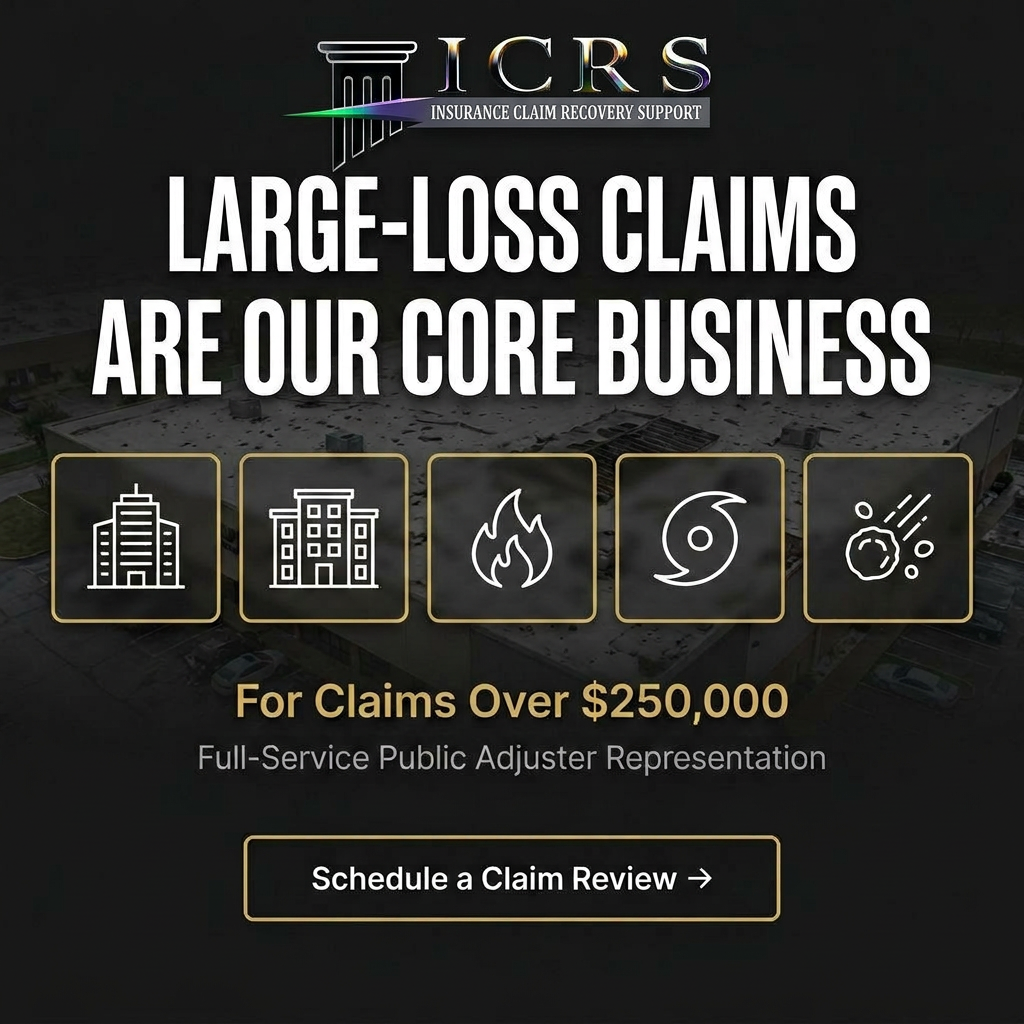
Our Core Focus: Representing Large-Loss Policyholders
At Insurance Claim Recovery Support, large-loss claims are our primary focus.
We represent commercial and multifamily property owners in complex, high-value insurance claims and provide full-service public adjusting on a contingency basis.
Our role includes:
- Comprehensive policy analysis
- Detailed damage documentation and valuation
- Coordination with engineers, contractors, and experts
- Preparation of a complete, evidence-backed claim
- Strategic negotiation with the insurance company
- Driving fair and timely settlements without unnecessary litigation
If you’re dealing with a specific type of loss, these guides can help:


For Commercial, Multifamily & High-Value Property Claims Over $250K
Large-Loss Insurance Claims:
Where Expert Representation Matters Most
Not all insurance claims are the same.
When damages exceed $250,000 after deductible, your claim requires more than general guidance—it requires full-service expert representation.
Insurance companies treat large-loss claims differently because the financial exposure is higher. These claims often involve engineers, consultants, multiple inspections, coverage disputes, business interruption issues, and aggressive settlement positions.
At Insurance Claim Recovery Support, we represent commercial, multifamily, and high-value property owners in complex large-loss claims on a contingency basis.
Types of Large-Loss Claims We Handle:
Commercial property claims Multifamily HOA and Apartment claims Religious Organizations Historical Buildings Medical Facilities High-value custom home claims Fire, hurricane, hail, tornado, water, wind, and freeze losses Business interruption and income loss Disputed, delayed, or underpaid claims
Our Role Is Simple:
We document the loss, interpret the policy, coordinate experts, negotiate with the insurance company, and pursue a fair and timely settlement—without unnecessary litigation whenever possible.
While smaller claims can often be managed with guidance and support, large-loss property insurance claims require a completely different level of expertise, strategy, and advocacy.
These claims are not just about repairs—they involve:
- Complex policy interpretation
- Multiple buildings or systems
- Hidden and progressive damage
- Code upgrades and compliance issues
- Business interruption losses
- Engineering and structural evaluations
- Large financial exposure for the insurance company
When a claim reaches this level, the process becomes significantly more technical—and the stakes become much higher.
What Defines a Large-Loss Claim?
Large-loss claims typically involve:
Damages exceeding $250,000 after deductible Commercial properties and portfolios Multifamily and apartment communities High-value custom homes Fire, hurricane, tornado, hail, and freeze events Business interruption and income loss Disputed scope, valuation, or coverage
These are the types of claims where insurance companies deploy their most experienced adjusters, consultants, and legal resources.
When Should You Hire a Public Adjuster for a Large Claim?
You should consider hiring a public adjuster when your claim involves significant financial exposure, complex damage, or disputed coverage. This is especially true when:
- damages may exceed $250,000 after deductible
- the insurance company is delaying, disputing, or underpaying the claim
- the property is commercial, multifamily, institutional, or high-value residential
- business interruption or income loss is involved
- engineers, consultants, or multiple inspections are part of the process
The larger the loss, the more important it becomes to have your own expert involved early.
Common Mistakes Property Owners Make
One of the biggest risks is relying on the wrong people early in the process.
For example: Many contractors present themselves as claim experts—but their role is to repair, not to interpret policy or negotiate coverage. In nearly every state, contractors do not have any authority to interpret policy, compel insurers to perform, negotiate or settle a property damage insurance claim and insurance companies know it.
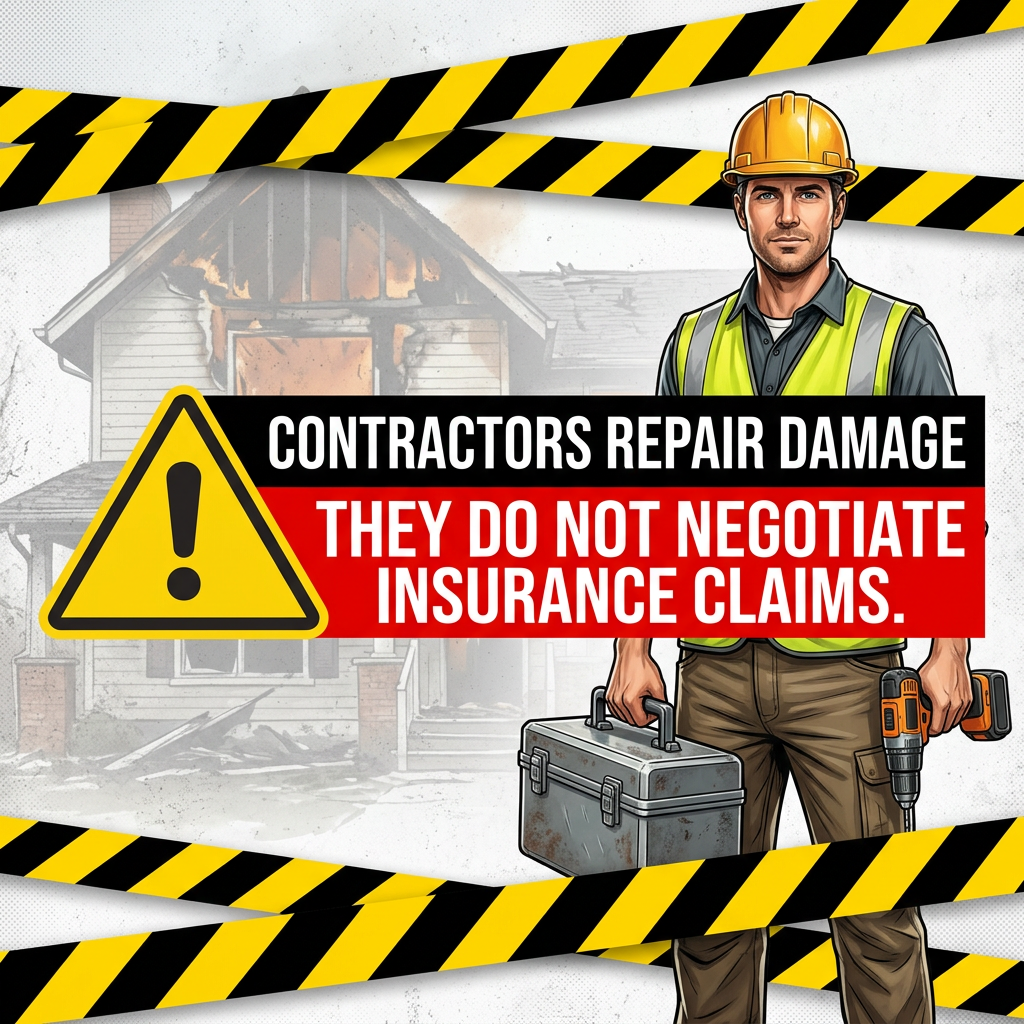
Learn more here: Stop Crooked Contractors
How a Public Adjuster Levels the Playing Field
At Insurance Claim Recovery Support, we help policyholders:
- Analyze policy coverage
- Build comprehensive claim documentation
- Coordinate expert evaluations
- Manage communication with insurers
- Negotiate for fair and timely settlements
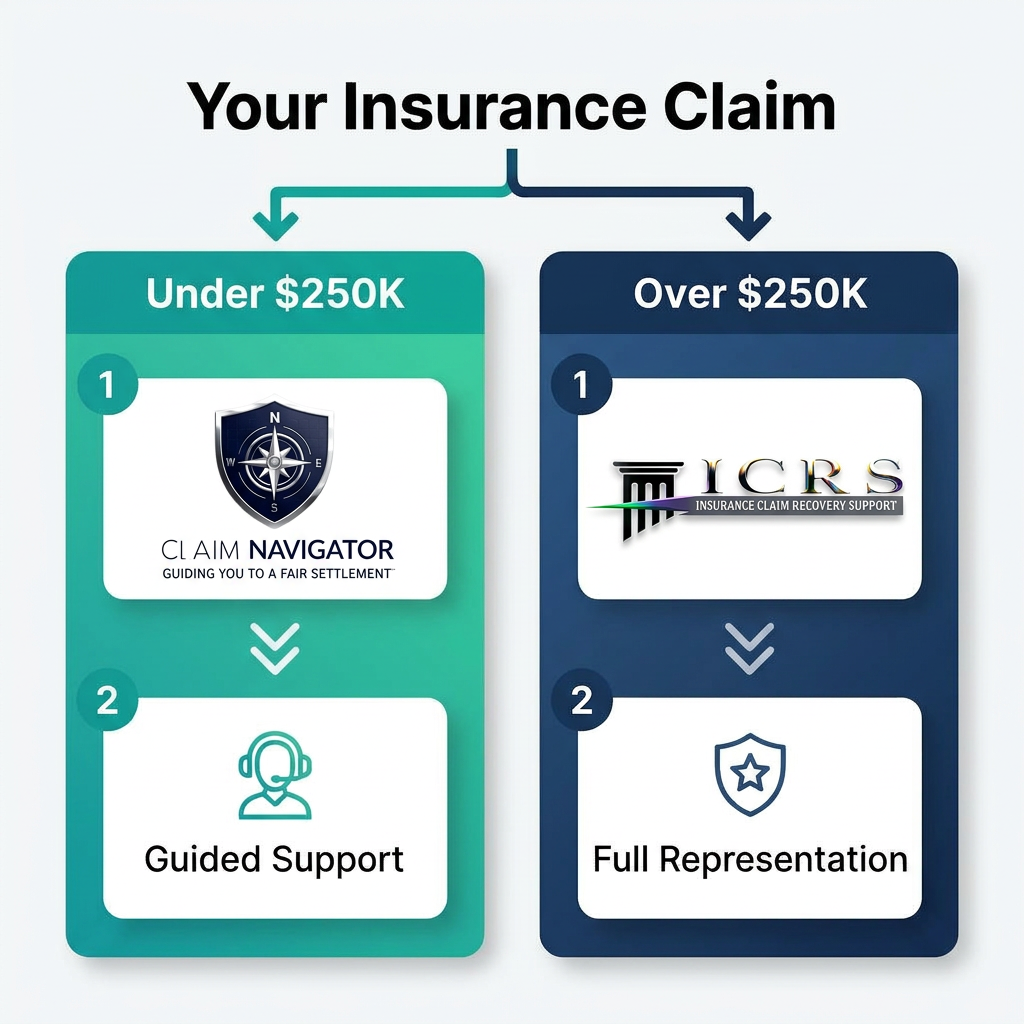
For claims under $250K, we also offer guided support through: ClaimNavigator
Two Paths for Your Insurance Claim
Why Large-Loss Claims Are Handled Differently
In large-loss situations, insurance companies approach the claim with greater scrutiny because of the financial exposure involved.
This often results in:
- More inspections and expert reports
- Tighter control over scope and pricing
- Increased reliance on policy exclusions and limitations
- More aggressive negotiation strategies
- Longer timelines and more complex communication
For property owners, this can feel like the process becomes more difficult the larger the claim gets.
How Our Large Loss Representation is Different From ClaimNavigator
- ClaimNavigator → Guided support for smaller claims (nominal flat fee)
- ICRS Public Adjusting → Full-service representation for large-loss claims (contingency-based)
If your claim involves significant damages or complexity, it likely falls into the category where full representation—not just guidance—is critical.
Do You Qualify for Large-Loss Representation?
If your claim meets these criteria, you may qualify:
Damages appear to exceed $250,000 after deductible The property is commercial, multifamily, or high-value residential The claim involves fire, storm, hail, tornado, hurricane, freeze, or water damage The insurance company delayed, underpaid, disputed, or denied part of the claim
Get a Professional Review of Your Claim
Before moving forward, it’s important to understand which path is right for your situation.
When Should You Hire a Public Adjuster?
You should strongly consider hiring a public adjuster when:
- The loss is significant
- The claim is complex
- You own commercial or multifamily property
- The insurance company is delaying or disputing
- The settlement seems low
- There are multiple buildings or systems involved
- The process is confusing, frustrating, or stressful especially at the beginning.
- The larger the loss, the more complex the claim, the sooner you engage a good qualified public adjuster, the better it will be for your recovery time and settlement amount.
Why Large Loss Claims Require Expertise
Large-loss claims often involve:
- Hidden damage
- Code upgrades
- Business interruption losses
- Engineering disputes
- Multiple stakeholders
Without proper documentation and strategy, these elements can be undervalued or overlooked.
Can a Public Adjuster Help Avoid Litigation?
In many cases, yes.
A properly documented claim reduces ambiguity and strengthens negotiation—often helping resolve claims without unnecessary litigation.
Your Countermove: Assembling Your Own Expert Team
The most effective response is to assemble your own team, led by a public adjuster. Unlike the company adjuster, a public adjuster works exclusively for you. At Insurance Claim Recovery Support, we specialize in large commercial and multifamily property damage claims from fire, hurricane, tornado, and freeze events across Texas.
Here’s how we level the playing field:
- Expert Policy Interpretation: We dissect your complex commercial policy to identify all areas of coverage, ensuring nothing is overlooked.
- Thorough Damage Valuation: We conduct our own detailed assessment of the damage, using construction expertise and sophisticated software to document the full cost of repairs, including hidden damage and code-required upgrades.
- Comprehensive Claim Preparation: The burden of proof is on you. We build an airtight claim with compelling evidence, including detailed estimates and documentation, leaving little room for dispute. For complex claims, we bring in forensic accountants to calculate business interruption losses or building engineers to assess structural damage.
- Skilled Negotiation: We handle all communications and negotiations with the insurer, countering their tactics to secure the maximum settlement you’re entitled to.
Are Public Adjusters Worth It?
For large and complex claims, the answer is often yes.
We’ve seen claim recoveries increase from 30% to over 3,800% higher than initial insurance company estimates.
How Public Adjusters Get Paid
Public adjusters typically work on a contingency basis.
In Texas:
- Fees are capped at 10%
- No recovery = no fee
Over 20 Years in Insurance Claims Insurance Claim Recovery Support LLC
We work with:
- Commercial property owners
- Multifamily and apartment owners
- High-value custom homes
- Property managers
- Religious and institutional properties
Find a Public Insurance Adjuster Near You (Coming Soon)
We are building a nationwide directory to help property owners connect with qualified professionals:
publicinsuranceadjusternearme.com directory – coming soon
Get Help With Your Claim
If you’re dealing with a significant property loss, you don’t have to navigate it alone.
Start here:

Or explore your options:
Final Thought
When you’re facing a large-loss insurance claim, you’re not just dealing with damage—you’re navigating a system.
Insurance companies have experts working for them.
You should too™.
Fact vs. Myth: Common Questions About Public Adjusters
Myth: “The insurance company’s adjuster is on my side.”
Fact: The company adjuster works for the insurance company. Their primary loyalty and financial incentive are to protect their employer’s interests, which means minimizing your payout.
Myth: “Hiring a public adjuster will slow down my claim.”
Fact: The opposite is often true. By submitting a thorough, professionally prepared claim from the start, we prevent the common back-and-forth and documentation requests that cause delays. Our goal is to get you a fair settlement efficiently and help you avoid lengthy litigation.
Myth: “I’ll get less money if I pay a public adjuster.”
Fact: Statistics show that policyholders who hire public adjusters receive significantly higher settlements. Even after our contingency fee, our clients typically walk away with a much larger net settlement than they would have on their own.
FAQ: What types of claims do you handle?
We specialize in large-scale property damage claims for commercial buildings, apartment complexes, multifamily HOAs, and religious institutions resulting from fire, hurricane, flood, tornado, and freeze events. We do not handle health or renter’s insurance claims.
FAQ: How does a public adjuster help avoid lawsuits?
By building a comprehensive, evidence-backed claim, we leave little room for the insurer to dispute the facts. This professional approach forces the insurance company to negotiate fairly and often results in a settlement without the need for costly and time-consuming litigation. We provide the leverage needed to get you paid without going to court. For more information, check out our explanation of what does a claims adjuster do.
The Two Paths: Public Adjuster vs. Insurance Claim Lawsuit
When you file a major property damage claim, you face a choice. The path you take will dramatically impact your timeline, settlement, and stress level.
Path 1: Hiring a Public Adjuster (The Proactive Approach)
- Maximize Your Settlement: Leverage expert knowledge to get the full amount you’re owed.
- Accelerate Your Claim: Avoid bureaucratic delays with a professionally managed process.
- Avoid Unnecessary Litigation: Compel a fair settlement through expert negotiation, not a lengthy court battle.
- Reduce Your Stress: Offload the work and worry to a professional advocate so you can focus on your business.
Path 2: Going It Alone (The Reactive Path)
- Risk Underpayment: Accept a lowball offer without knowing the true value of your claim.
- Face Wrongful Denials: Struggle to counter the insurer’s complex arguments for denying coverage.
- Endure Prolonged Lawsuits: Get dragged into years of costly and stressful litigation if you dispute the outcome.
- Suffer Business Disruption: Lose valuable time and focus fighting the insurer instead of running your property.
The choice is clear. To protect your investment, having your own expert isn’t just an option—it’s a necessity. For more insights, visit our guide on Commercial Insurance Claims.
Conclusion: Secure Your Recovery with a Professional Advocate
The core message is simple: insurance companies have experts working for them, you should too. Facing their team of adjusters, lawyers, and risk managers alone is a battle you are not equipped to win. They are professionals at minimizing claims, and it’s their full-time job.
At Insurance Claim Recovery Support, we level the playing field. As your public adjuster, we work exclusively for you. We bring the expertise in policy interpretation, damage valuation, and negotiation needed to counter the insurer’s tactics and secure the full settlement you deserve. Our clients consistently see significantly higher recoveries—often enough to avoid costly litigation and get back to business faster.
We’ve helped commercial and multifamily property owners across Texas—from Houston and San Antonio to Austin and Dallas-Fort Worth—recover from devastating fires, hurricanes, freezes, and tornadoes. We handle the entire claims process on a contingency basis, so you can focus on your recovery with peace of mind.
Don’t let the insurance company dictate the value of your loss. Let us be your professional advocate and secure the fair settlement you are rightfully owed.