Why Understanding Insurance Claim Legislation Texas is Critical for Property Owners
Insurance Claim Legislation Texas governs how insurers handle property damage claims, but a troubling reality has emerged: nearly half of all property insurance claims in Texas are closed without payment. This trend leaves commercial property owners and multifamily operators shouldering massive repair costs for losses they believed were covered.
Understanding your rights is the first step to securing a fair settlement. Texas law provides a framework of deadlines and protections for policyholders.
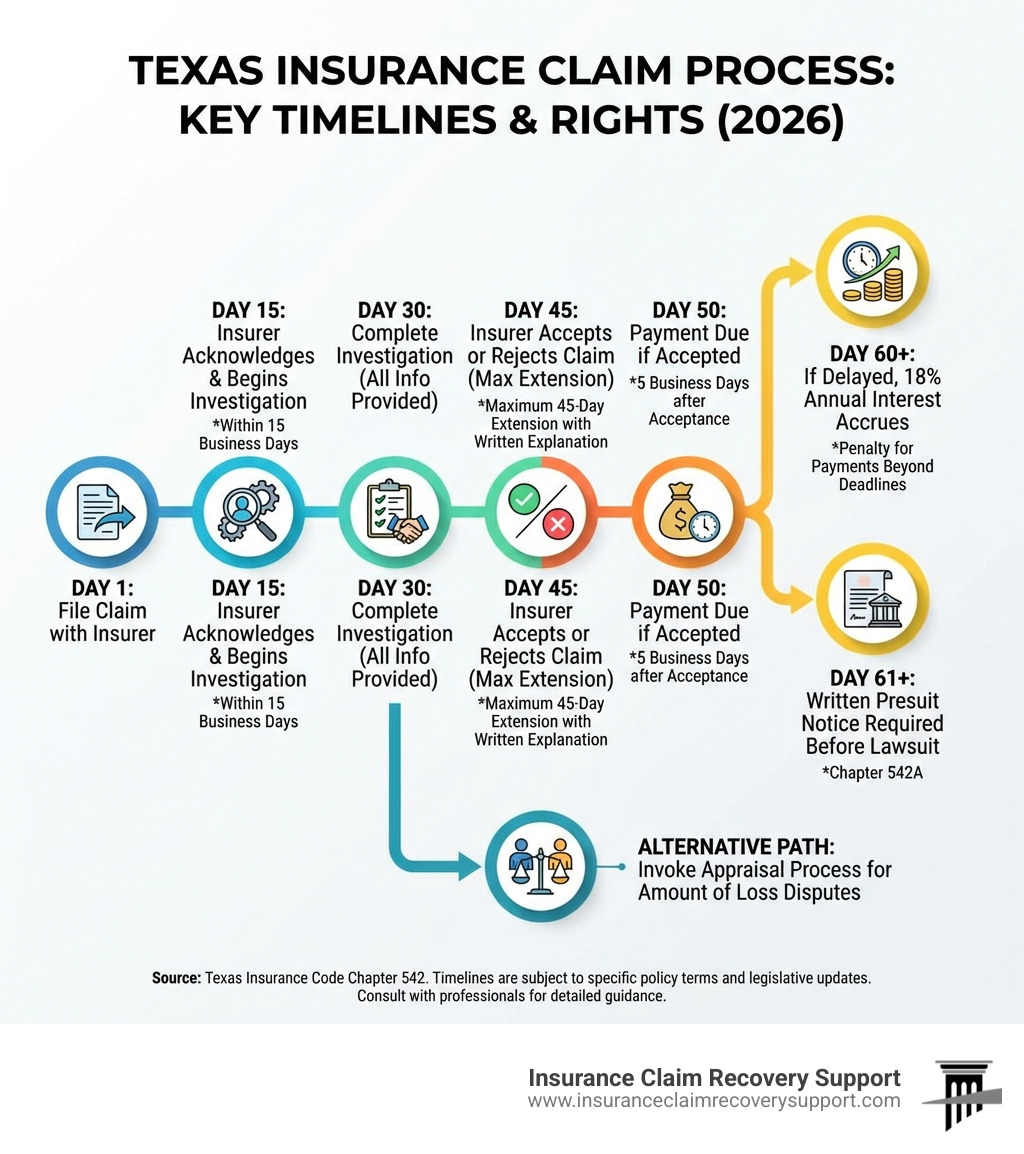
Key Texas Insurance Claim Deadlines:
- 15 business days – To acknowledge your claim and begin an investigation.
- 15 business days – To accept or reject your claim after receiving all necessary information (can be extended to 45 days with a written explanation).
- 5 business days – To pay an accepted claim.
- 61 days – Required written notice before you can file a lawsuit (Chapter 542A).
- 18% annual interest – Penalty insurers may owe for delayed payments.
Your Core Protections Under Texas Law:
✅ Right to prompt claim handling and investigation.
✅ Protection against unfair settlement practices.
✅ Access to alternative dispute resolution like appraisal.
✅ Right to file complaints with the Texas Department of Insurance (TDI).
✅ Right to reopen claims for newly finded damages.
Recent legislative changes have created a complex environment. Laws like House Bill 1774 (2017) added problems for policyholders filing lawsuits, while newer legislation aims to restore some protections. For commercial and multifamily owners facing major losses from fire, hurricanes, or hail, navigating these laws is crucial.
As public adjusters with over 15 years of experience in Texas, we’ve seen how a deep understanding of these laws helps clients maximize their claim outcomes and avoid unnecessary litigation. This guide will break down what Texas law requires, how recent changes affect you, and the best strategies for securing fair compensation.
Your Rights & Insurer Duties Under Texas Insurance Claim Legislation
When your commercial property is damaged, knowing your rights is your first line of defense. Texas law outlines specific duties and timelines for insurance companies. At Insurance Claim Recovery Support, we help property managers and commercial owners across Texas steer these complexities.
The Policyholder Bill of Rights: Key Deadlines and Protections
The Texas Insurance Code, particularly Chapter 542 (the Unfair Claim Settlement Practices Act), is the cornerstone of policyholder protection. It mandates specific timelines for handling your claim.
Upon receiving written notice of a claim, your insurer generally has:
- 15 days to acknowledge the claim and begin an investigation.
- 15 business days after receiving all necessary information to notify you in writing whether they will accept or reject your claim. They can extend this by 45 days if they provide a written explanation.
- 5 business days to pay the claim after notifying you of acceptance.
If an insurer fails to meet these deadlines, they may be liable for an 18% annual interest penalty on the claim amount, plus attorney’s fees. The Act also prohibits unfair practices like misrepresenting policy provisions, failing to conduct prompt investigations, and not attempting good faith settlements when liability is clear. The Texas Department of Insurance (TDI) enforces these regulations, and you can file a complaint if you believe your insurer is non-compliant.
The Impact of House Bill 1774 on Property Damage Lawsuits
Enacted in 2017, House Bill 1774 (Chapter 542A of the Insurance Code) significantly changed the process for suing an insurer over certain property damage claims, including those from severe weather. It created new problems for policyholders, making litigation riskier and more complex.
Key provisions include:
- 61-Day Presuit Notice: Before filing a lawsuit, you must give the insurer 61 days’ written notice detailing the issue, the amount you believe you are owed, and any attorney’s fees incurred. Failure to do so can result in the suspension of your lawsuit.
- Attorney’s Fees Limitations: The law introduced a formula that can severely limit or even eliminate your ability to recover attorney’s fees. If your final judgment is less than 80% of the amount you demanded in your presuit notice, your attorney’s fee award may be reduced or denied entirely.

While intended to encourage pre-lawsuit resolution, HB 1774 has placed a heavier burden on policyholders. This shift underscores the value of skilled advocacy and alternative dispute resolution methods to resolve claims before a lawsuit becomes necessary.
Navigating Contractor Regulations: HB 2102 & HB 2103
Texas law also regulates contractors’ involvement in insurance claims to prevent fraud and conflicts of interest.
-
House Bill 2102 (The Deductible Law): This law makes it illegal for a contractor to pay, waive, or rebate your insurance deductible. Policyholders are legally required to pay their deductible. Insurers can request proof of payment before releasing funds for replacement costs. This ensures claim values are not artificially inflated.
-
House Bill 2103 (Conflict of Interest Law): This bill prohibits contractors from acting as public adjusters on the same claim for which they are providing repair services. A contractor’s interest is in the repair job, while a public adjuster’s sole duty is to advocate for the policyholder’s financial recovery. This law ensures you can have an independent advocate negotiating on your behalf without a conflict of interest.
Resolving Disputes and Maximizing Your Commercial Property Claim
When disputes arise over a large-loss commercial property claim, Texas law provides mechanisms to help you secure a fair recovery without resorting to costly litigation.
The Appraisal Process: A Powerful Tool for Dispute Resolution

Appraisal is a form of alternative dispute resolution built into many commercial property policies. It is specifically designed to resolve disagreements over the amount of a covered loss, not whether the loss is covered.
How the Appraisal Process Works:
- Invocation: Either you or your insurer can demand appraisal when there is a dispute over the value of the damages.
- Appraiser Selection: Each party selects a competent, disinterested appraiser.
- Umpire Selection: The two appraisers agree on a neutral umpire. If they cannot agree, a court may appoint one.
- Binding Decision: The appraisers assess the loss. If they agree on a value, it is binding. If they disagree, they submit their differences to the umpire. An agreement by any two of the three parties sets the final amount of the loss.
Recent legislative pushes like Senate Bill 458, while not directly mandating appraisal for commercial policies, reinforce its importance as a faster and less costly alternative to litigation. For commercial property owners, using the appraisal clause in your policy is a highly effective strategy to resolve valuation disputes.
Public Adjuster vs. Lawsuit: The Path to Fair Recovery
When facing an unsatisfactory settlement offer, you have two primary paths: hiring a public adjuster or filing a lawsuit. For commercial property owners, understanding the difference is key to an efficient recovery.
| Feature | Pursuing a Lawsuit (Litigation) | Engaging a Public Adjuster (e.g., Insurance Claim Recovery Support) |
|---|---|---|
| Process | Formal legal proceedings, findy, depositions, trials. Governed by court rules. | Claim investigation, documentation, estimation, negotiation with insurer. Governed by insurance policy and TDI regulations. |
| Cost | High. Attorney’s fees, court costs, expert witness fees. HB 1774 limits fee recovery. | Contingency fee (percentage of the recovered amount). No upfront costs. We are only paid if we increase your settlement. |
| Timeline | Long. Can take months or years. | Significantly shorter. Typically weeks to a few months. |
| Focus | Legal precedent, proving bad faith, recovering damages. | Maximizing settlement within policy limits, accurate loss valuation, and effective negotiation. |
| Outcome | Uncertain. Risky for policyholders due to HB 1774. | High success rate. We have a 90% settlement success rate without unnecessary lawsuits. |
Our firm, Insurance Claim Recovery Support (ICRS), specializes in maximizing settlements for policyholders while avoiding litigation where possible. Our approach focuses on thorough documentation and expert negotiation to secure what you are owed under your policy. While lawsuits are an option for bad faith claims, the post-HB 1774 landscape makes them challenging. Our proactive strategy often achieves a better outcome more efficiently, saving you time, money, and stress.
What to Do When Your Claim is Denied, Delayed, or Underpaid
Facing a claim denial, delay, or lowball offer is frustrating but not final. With nearly half of Texas property claims closed without payment, it’s crucial to act strategically.
Here’s what to do:
- Document Everything: Keep a detailed journal of all communications. Save every email, letter, and document. Take extensive photos and videos of the damage.
- Demand a Written Explanation: Insurers must provide their reasons for a denial or underpayment in writing. Review this carefully to understand their position.
- Get Independent Estimates: Don’t rely on the insurer’s assessment. Obtain detailed repair estimates from your own trusted, independent commercial contractors.
- File a TDI Complaint: Filing a complaint with the Texas Department of Insurance creates an official record and can prompt the insurer to review your claim. You can call their hotline at 800-252-3439.
- Reopen or Supplement Your Claim: If new damages are finded, you have the right to file a supplemental claim. You can also provide new evidence to reopen a claim that was closed without payment.
- Seek Professional Advocacy: For complex, denied, or underpaid claims, engaging a licensed public adjuster is your most effective step. We represent your interests exclusively, handling all communications and negotiations to maximize your settlement. Get professional help with your claim.
Fact vs. Myth: Common Questions About Texas Insurance Claims
Misconceptions about Insurance Claim Legislation Texas can lead to costly mistakes for commercial and multifamily property owners. Let’s separate fact from fiction.
**Myth 1: “My insurer must pay my claim within 15 days.”
Fact: The timelines are more nuanced. An insurer generally has 15 business days to acknowledge your claim and another 15 business days to accept or reject it after receiving all necessary information. The 5-business-day deadline applies to paying an already accepted claim. The entire process from filing to payment usually takes longer than 15 days.
**Myth 2: “If my claim is denied, I have no further options.”
Fact: A denial is a starting point for negotiation, not the end. You can provide additional evidence, file a complaint with the Texas Department of Insurance (TDI), invoke appraisal for valuation disputes, or file a supplemental claim for new damages. Engaging a public adjuster is a powerful step to challenge a denial and negotiate a fair settlement.
**Myth 3: “Hiring a public adjuster means I can’t pursue legal action later.”
Fact: Incorrect. Hiring a public adjuster does not waive your right to sue. Our goal at Insurance Claim Recovery Support is to achieve a full settlement without litigation. However, if an insurer acts in bad faith, you retain all legal options. The detailed documentation we prepare often strengthens a potential legal case.
**Myth 4: “All contractors can negotiate with my insurer on my behalf.”
Fact: False and illegal. House Bill 2103 prohibits contractors from acting as public adjusters on a property where they may perform repairs. A contractor’s job is to estimate and perform repairs. A public adjuster’s sole duty is to advocate for your financial interests in the claim settlement. This law prevents a clear conflict of interest.
**Myth 5: “Appraisal is always binding and final.”
Fact: An appraisal award is binding on the amount of loss, but it doesn’t resolve coverage disputes (i.e., whether something is covered at all). An award can also be challenged in court in rare cases of fraud or a significant mistake in the process. It is a powerful tool for valuation disputes but may not be the final word on every aspect of a claim.
**Myth 6: “Filing a complaint with TDI is complicated and ineffective.”
Fact: The TDI has a straightforward complaint process, and it can be an effective tool. While the TDI cannot force an insurer to pay a specific amount, its investigation can pressure the insurer to re-evaluate your claim and correct unfair practices. It’s an important step in holding insurers accountable.
Learn more about the benefits of a public insurance adjuster at www.whatisapublicadjuster.com