When Your Hurricane Claim Is Denied: What Commercial Property Owners Need to Know
Hurricane claim denied is one of the most frustrating outcomes a commercial or multifamily property owner can face after a catastrophic storm — and it happens far more often than most people realize.
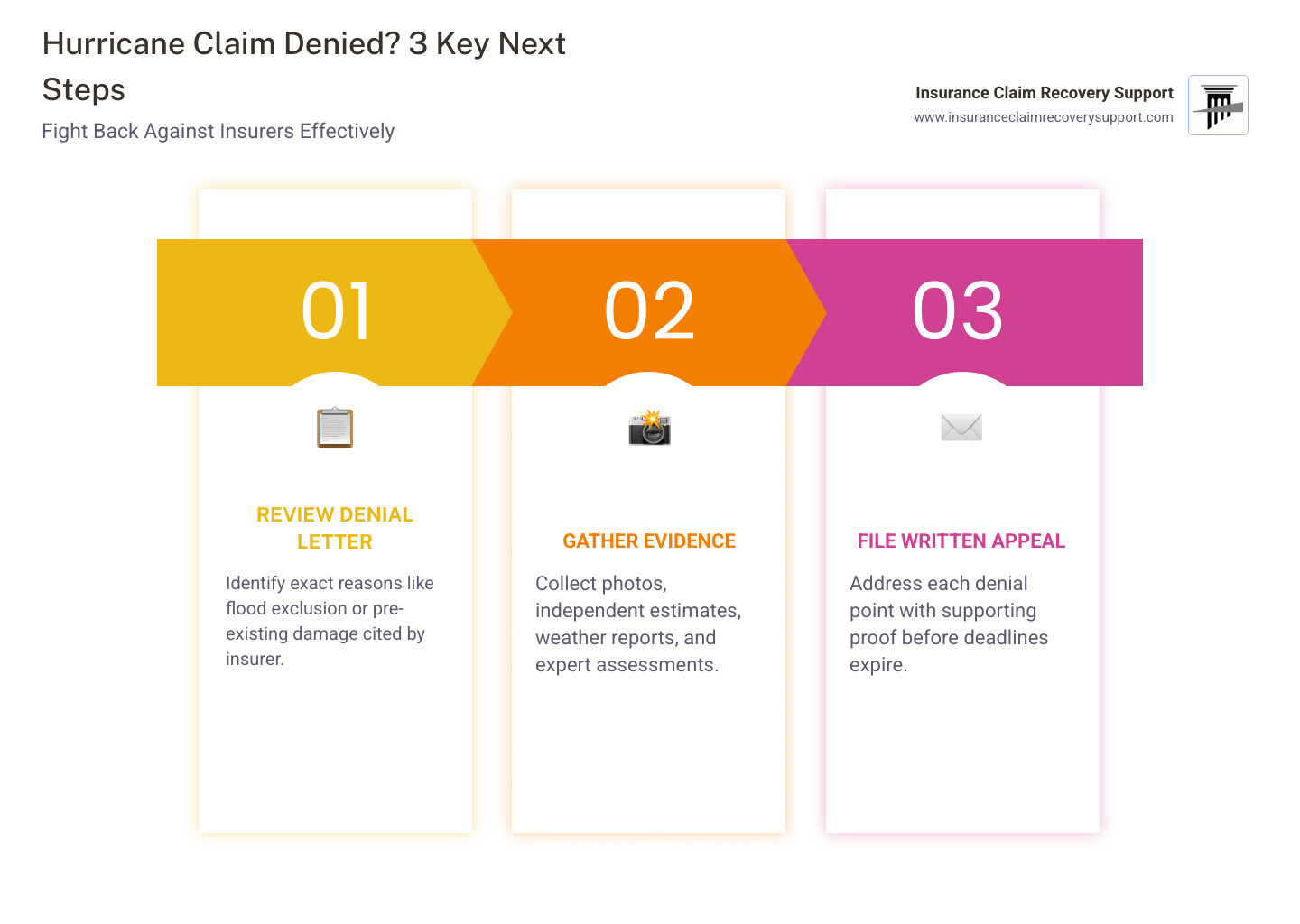
Here’s a quick look at what you can do if your hurricane claim was denied:
- Review your denial letter carefully — identify the exact reason given (e.g., flood exclusion, below deductible, pre-existing damage)
- Determine if your claim is fully denied or just underpaid — these require different strategies
- Gather additional documentation — photos, independent repair estimates, weather reports, and expert assessments
- Submit a written appeal — address each denial reason point by point with supporting evidence
- Hire a public adjuster — they can negotiate directly with your insurer, often without the need for litigation
- Know your deadlines — state laws and your policy set strict timelines for appeals and lawsuits
After Hurricanes Helene and Milton, Florida’s Office of Insurance Regulation reported denial rates of 53% and 39% respectively for residential claims — and commercial properties faced equally daunting odds. For property owners managing office buildings, apartment complexes, hotels, or other large-loss assets, a denied claim doesn’t just mean a repair bill. It means tenant pressure, lost revenue, lender complications, and months of uncertainty.
The reasons insurers deny hurricane claims range from legitimate policy exclusions — like flood damage not being covered under a standard property policy — to more troubling tactics like misclassifying wind damage, citing vague wear-and-tear language, or underestimating the scope of repairs. Understanding which category your denial falls into is the critical first step.
The good news: a denial letter is not the final word.
I’m Scott Friedson, a multi-state licensed public adjuster and CEO of Insurance Claim Recovery Support (ICRS), with over 15 years of experience and more than 500 large-loss claims — including many where I’ve successfully overturned a hurricane claim denied decision without resorting to costly litigation. In the sections below, I’ll walk you through exactly why these denials happen and the most effective strategies to fight back.
Hurricane claim denied terms explained:
Why Was Your Hurricane Claim Denied?
Receiving a denial letter after a catastrophic storm feels like a second disaster. For commercial property owners in coastal regions like Houston, Galveston, or across the Florida peninsula, the stakes are incredibly high. When an insurer issues a hurricane claim denied notice, they aren’t just saying “no”; they are making a legal assertion based on their interpretation of your policy.
One of the most complex hurdles in hurricane recovery is the “wind vs. water” dispute. Most standard commercial property policies cover wind damage but explicitly exclude flood damage. This creates a massive grey area during a hurricane where both 150-mph winds and massive storm surges occur simultaneously. Insurers often lean on “anti-concurrent causation” clauses. These clauses state that if a loss is caused by two perils—one covered (wind) and one excluded (flood)—the entire claim may be denied if the excluded peril contributed in any way.
Understanding the nuances of Loss Types: Flood Damage Insurance Claims is essential. If you own property in inland hubs like San Antonio, you might think you’re safe from these disputes, but localized flooding from heavy rainfall can trigger the same exclusions. Our team often sees San Antonio Flood Damage claims get tied up in these exact wind-vs-water arguments.

Common Reasons for a Hurricane Claim Denied
Recent data from the Florida Office of Insurance Regulation (OIR) provides a sobering look at why claims are closed without payment. For Hurricane Milton, a staggering 41% of closed claims resulted in no payment because the damage was “below deductible.” Hurricane deductibles for commercial properties are often calculated as a percentage of the total insured value (typically 2% to 5%), meaning a building insured for $10 million might have a $500,000 deductible. If the insurer’s adjuster “estimates” your roof damage at $450,000, your claim is effectively denied.
Other common reasons include:
- Lack of Flood Coverage: Approximately 20% to 21% of denials for recent hurricanes were attributed to a lack of flood insurance. Many owners assume “hurricane coverage” includes everything, but unless you have a separate policy or endorsement, rising water is usually excluded.
- Withdrawn Claims: About 8% of claims are withdrawn by the insured, often because the process becomes too overwhelming or they believe the insurer’s initial (and often incorrect) assessment that the damage isn’t covered.
- Lack of Other Coverages: This includes exclusions for specific items like fences, signage, or landscaping which may not be part of the main building policy.
Policy Exclusions and Bad Faith Tactics
Insurers are businesses, and after a multi-billion dollar storm event, they look for ways to limit their liability. One of the most common tactics is blaming “wear and tear” or “pre-existing damage.” We’ve seen cases where an insurer denies a roof claim by arguing the shingles were already deteriorating due to age, even if the hurricane clearly ripped them off.
“Bad faith” occurs when an insurer fails to fulfill its legal obligations to the policyholder. This can include:
- Unreasonable Delays: Failing to acknowledge or investigate a claim within statutory timeframes.
- Lowballing: Offering a settlement that is demonstrably lower than the actual cost of repairs.
- Misrepresenting Policy Terms: Telling a property owner that a certain type of damage is excluded when the policy language says otherwise.
- Failure to Investigate: Denying a claim based on a “desk adjusters” review without ever sending a qualified professional to inspect the site.
How to Overturn a Hurricane Claim Denied Letter
The first thing to understand is the difference between a “denied” claim and an “underpaid” claim. A denial means the insurer is paying $0. An underpaid claim means they acknowledge coverage but disagree on the “scope of work” or the “valuation.” Both can be challenged.
To overturn a denial, you must address the insurer’s specific reasoning with new evidence. If they claim the damage was pre-existing, you need pre-storm photos or maintenance records to prove the building was in good condition. If they claim it was flood damage, you may need a forensic meteorologist or an engineer to prove that wind-driven rain entered through a storm-created opening in the roof before the floodwaters arrived.
Once the insurer agrees to pay, the battle often shifts to the settlement amount. Knowing the Steps to Take After a Property Damage Insurance Claim is Settled can help you ensure that the final check actually covers the full cost of restoration.
How to Fight Back: The Path to Recovery
Fighting a hurricane claim denied decision requires a proactive, evidence-based approach. You cannot simply tell the insurance company they are wrong; you have to prove it using the language of their own policy.
One of the most important tools in your arsenal is a “certified copy” of your full insurance policy. This is not just the 2-page “Declarations” page; it is the 60+ page document containing all endorsements, exclusions, and conditions. Insurers often rely on the fact that most property managers haven’t read the fine print. By reviewing the full document, we can often find “carve-outs” or endorsements that provide coverage where the insurer initially claimed none existed.
This is especially vital for Commercial Property Damage Claims where business interruption and extra expense coverages are at play. In a Hurricane Texas scenario, for example, even if the physical damage is being disputed, you may still have valid claims for the loss of rental income or the cost of relocating tenants.
Immediate Steps to Appeal a Denial
If you receive a denial, your clock is ticking. Here is the roadmap we recommend:
- Mitigate Further Damage: Your policy requires you to protect the property. Tarp the roof and board up windows. Keep all receipts for these “emergency repairs.”
- Document Everything: Take hundreds of photos and videos. Don’t just show the damage; show the cause of the damage.
- Request an Independent Estimate: Do not rely on the insurance company’s adjuster. Hire a licensed contractor or a public adjuster to create a detailed, line-item estimate of the repairs needed.
- Write a Formal Appeal: This should be a professional, factual letter that addresses every point in the denial letter. Use your independent evidence to rebut their claims.
- Reference NFIP Guidelines: If your claim involves flood, ensure you are following the FEMA National Flood Insurance Program (NFIP) Guidelines for proof of loss and filing deadlines, which are often much stricter than standard policies.
Public Adjuster vs. Litigation: Choosing the Right Advocate
When a claim is denied, many property owners think their only option is to hire a lawyer and sue. While litigation is sometimes necessary, it is often the slowest and most expensive way to resolve a claim. At Insurance Claim Recovery Support (ICRS), we specialize in resolving these disputes through the administrative and appraisal processes, maintaining a 90% settlement success rate without unnecessary lawsuits.
| Feature | Public Adjuster (ICRS) | Insurance Attorney |
|---|---|---|
| Primary Goal | Maximize settlement through negotiation & evidence | Win a legal judgment or settlement via court |
| Timeline | Usually weeks or months | Often 1–3 years |
| Cost | Contingency fee (percentage of claim) | Contingency fee + court costs/expert fees |
| Expertise | Building science, policy language, estimating | Legal strategy, case law, litigation |
| Conflict Level | Collaborative but firm negotiation | Adversarial (Lawsuit) |
Choosing What is a Good Public Adjuster means finding someone who understands the technical side of the loss. For instance, if your denial involves rising water, you need a Public Insurance Adjuster for Flood Damage who can distinguish between storm surge and wind-driven rain—a distinction that can be worth millions of dollars to your bottom line.
Fact vs. Myth: Navigating Deadlines and Requirements
There is a lot of misinformation regarding insurance claims. Let’s clear up a few common myths:
Myth: I have two years to file my claim, so I can wait. Fact: While the statute of limitations might be two years, your policy likely has a “prompt notice” requirement. Waiting months to report damage—especially roof damage that can lead to mold—is a top reason for a hurricane claim denied result.
Myth: The insurance company’s adjuster is looking out for me. Fact: The company adjuster works for the insurance company. Their job is to settle the claim for the lowest defensible amount. A public adjuster works exclusively for you.
Myth: If I accept the first check, I can’t ask for more later. Fact: In most cases, you can accept an initial payment as “undisputed funds” and continue to negotiate for the remainder. Just be careful not to sign anything labeled “Full and Final Release” without professional advice.
In states like Texas, the “Texas Prompt Payment of Claims Act” sets strict deadlines for insurers to acknowledge, investigate, and pay or deny claims. If they miss these deadlines, they may owe you interest and attorney fees. Understanding Property Damage Insurance Claims in the Insurance Industry helps you hold carriers accountable to these rules.
If you are currently staring at a denial letter, don’t panic. You have options. We provide expert Help with Denied Hurricane Claims for commercial and multifamily owners across Texas and the Gulf Coast.
Conclusion: Don’t Let a Denial Be the Final Word
A hurricane claim denied notice is a challenge, not a defeat. Insurance companies often issue denials as a “first offer,” hoping that the property owner will simply go away or settle for pennies on the dollar. For owners of apartment complexes, retail centers, and industrial facilities, the cost of walking away is simply too high.
At Insurance Claim Recovery Support (ICRS), we see the “Recovery Ladder” as a structured way to climb out of a denial. We start by understanding the reason for the denial, gathering superior evidence, and filing a professional internal appeal. If that doesn’t work, we utilize the “Appraisal” clause found in most policies—a form of alternative dispute resolution that avoids the courtroom while still forcing a fair settlement.
Whether you are in Austin, Dallas, Houston, or San Antonio, our team is ready to advocate for your interests. We represent only the policyholder—never the insurance company. Our goal is to settle your claim fairly, fully, and as quickly as possible so you can get back to business.
If your hurricane claim was denied or underpaid, contact Insurance Claim Recovery Support today for a free, no-obligation claim review. Let us help you turn that “no” into the settlement you deserve.