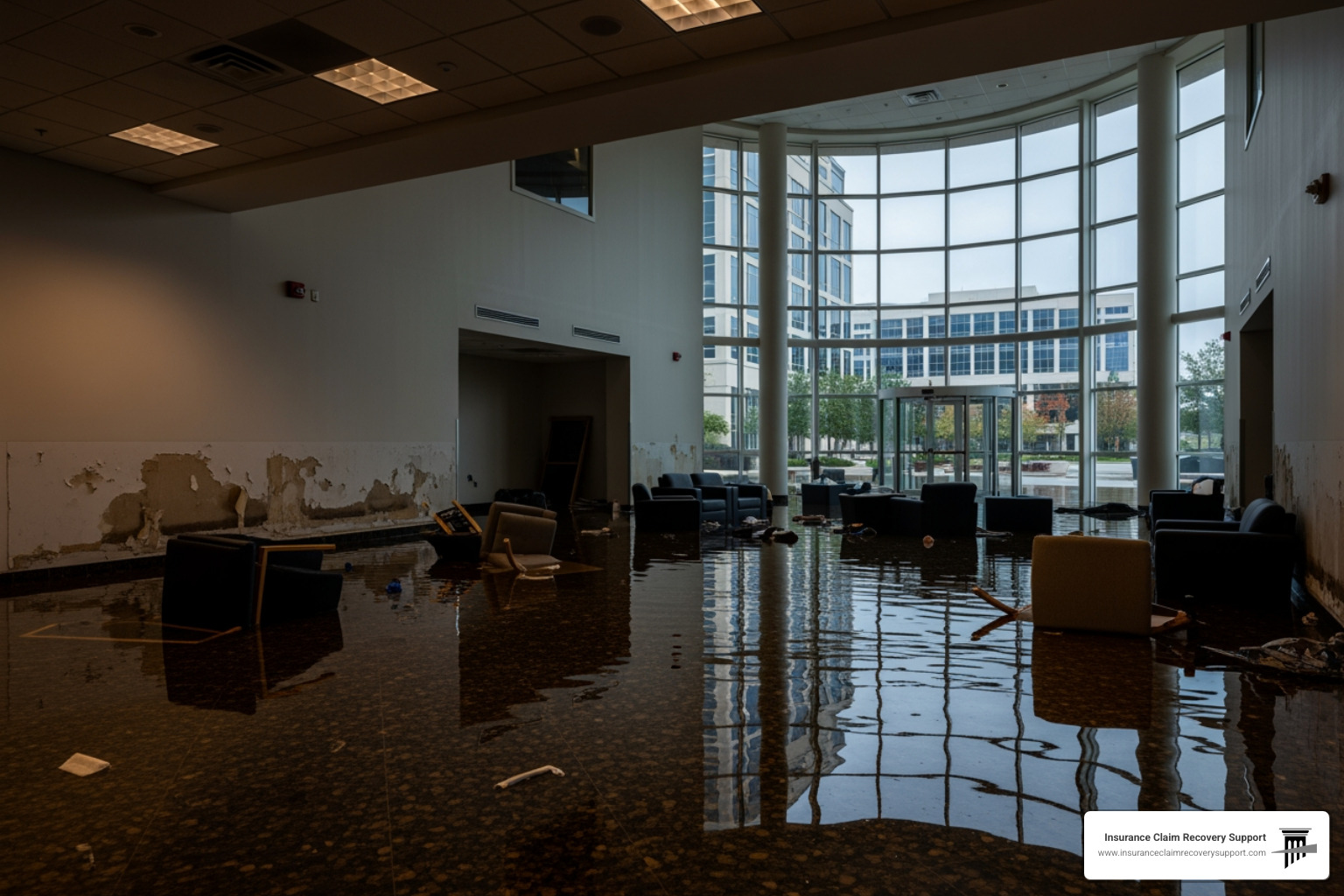
When Disaster Strikes Your Property: What You Need to Know First
Property damage insurance claims are formal requests you submit to your insurance carrier seeking compensation after a covered event — such as a fire, windstorm, flood, or vandalism — damages or destroys your property.
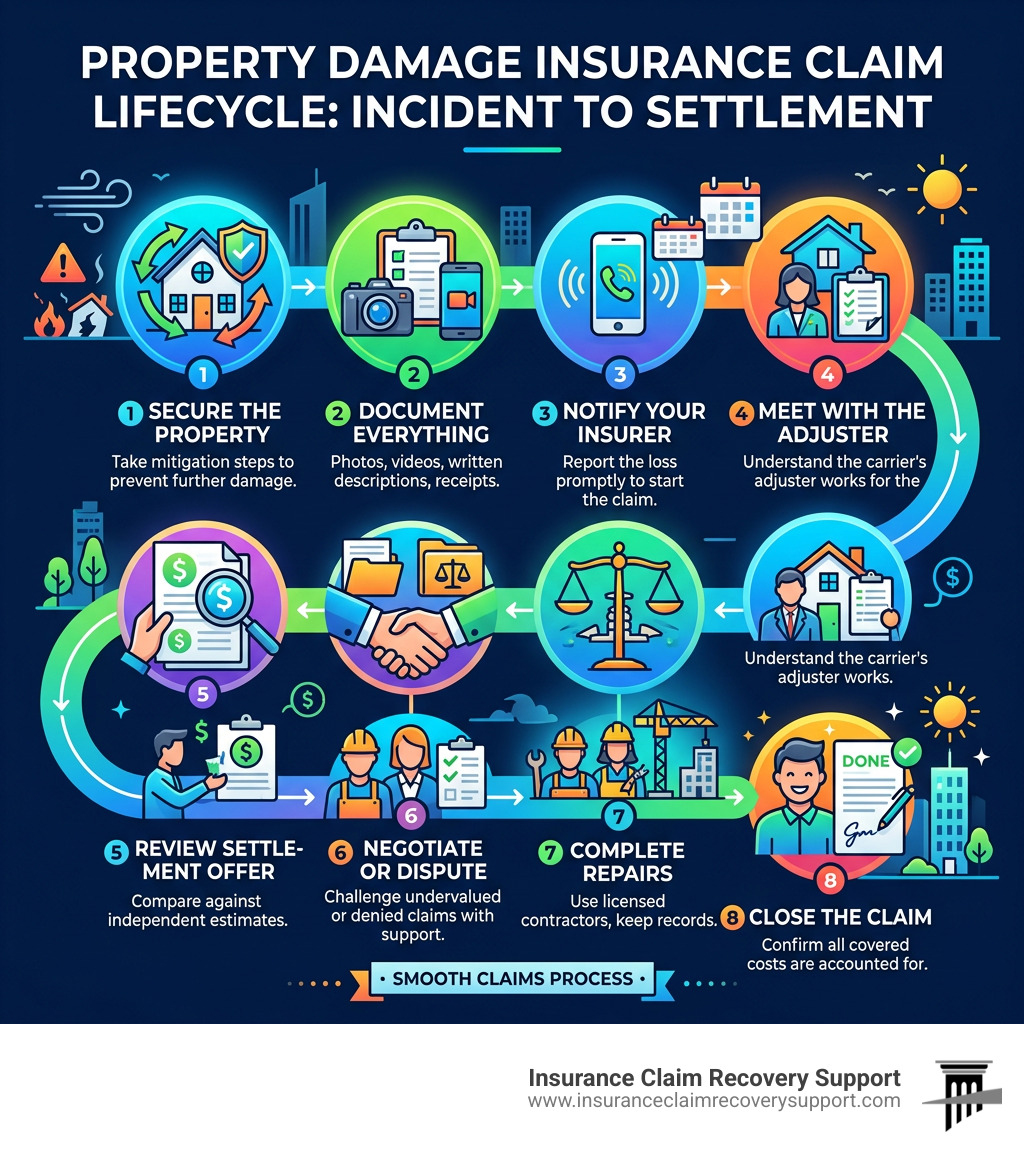
Here is a fast-reference overview of the claim lifecycle so you can orient yourself immediately:
- Secure the property – Take emergency mitigation steps to prevent further damage
- Document everything – Photos, videos, written descriptions, receipts
- Notify your insurer – Report the loss promptly; delays can jeopardize coverage
- Meet with the adjuster – Understand that the carrier’s adjuster works for the insurer, not for you
- Review the settlement offer – Compare against your own independent estimates
- Negotiate or dispute – Challenge undervalued or denied claims with evidence and professional support
- Complete repairs – Use licensed contractors and keep all records
- Close the claim – Confirm all covered costs are accounted for before signing any final release
If you own or manage a commercial building, apartment complex, hotel, or institutional property, the stakes are even higher. You are not just dealing with repair costs — you are managing tenant pressure, revenue loss, lender compliance, and business interruption, all at once. And the system is not making it easier.
In 2024 alone, 28 catastrophic weather events caused more than $92 billion in property damage across the United States. The average property insurance claim now takes nearly 24 days to cycle through — more than six days longer than the year before. Catastrophic claims made up 46% of all residential property claims in 2023, the highest share in seven years. And customer satisfaction with the entire property claims process has fallen to a seven-year low.
As Mark Garrett, Director of Insurance Intelligence at J.D. Power, put it: property policyholders are essentially paying higher prices for slower service.
That is the environment you are filing your claim in right now. 🚨
The good news? You have more options and more rights than most property owners realize — and knowing how to use them is the difference between a fair settlement and a prolonged, expensive dispute.
I’m Scott Friedson, Multi-State Licensed Public Adjuster and CEO of Insurance Claim Recovery Support (ICRS), and over 15-plus years I have personally settled more than 500 large-loss property damage insurance claims totaling over $250 million for commercial and multifamily property owners across the country. In the sections ahead, I will walk you through exactly how to navigate this process — from first notice of loss all the way to final settlement — without falling into the litigation trap that costs property owners time, money, and sanity.
Simple Property damage insurance claims glossary:
Navigating the Property damage insurance claims Process for Commercial Assets
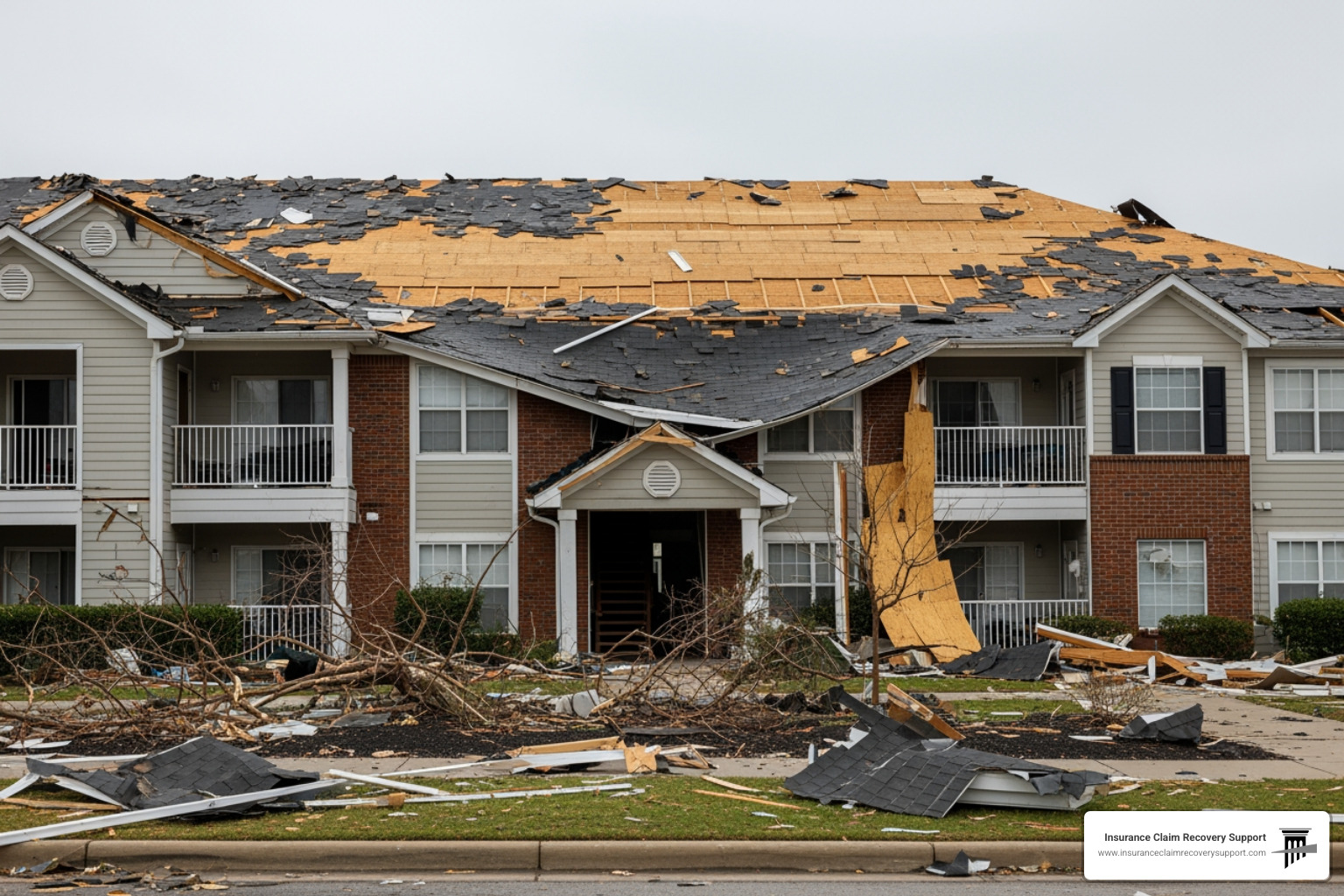
When we talk about commercial property insurance claims, we aren’t just talking about a leaky faucet. We are talking about massive roof failures on 100,000-square-foot warehouses, fire damage in high-rise office buildings, or hurricane-force winds stripping the siding off a 300-unit apartment complex.
The complexity of these claims requires a specialized approach. Unlike a standard home claim, a commercial loss often triggers a ripple effect of financial consequences. This is why understanding your business interruption complete guide is vital. If your retail center is dark for three months while you argue over a roof estimate, the loss of rental income might actually exceed the physical repair costs.
One of the first hurdles you will face is how the insurance company values your loss. Most policies use one of two methods: Replacement Cost Value (RCV) or Actual Cash Value (ACV). Understanding the difference is crucial for your bottom line.
| Feature | Replacement Cost Value (RCV) | Actual Cash Value (ACV) |
|---|---|---|
| Definition | Cost to replace with new materials of like kind/quality. | RCV minus physical depreciation (age/wear). |
| Payout Timing | Usually paid in two parts: ACV first, then the “holdback” after repairs. | Paid upfront as a lump sum based on current market value. |
| Out-of-Pocket | Minimizes your out-of-pocket costs for new materials. | You pay the difference between the check and the actual repair cost. |
| Policy Premium | Generally higher premiums for better coverage. | Lower premiums, but higher financial risk during a claim. |
Essential Steps for Filing Property damage insurance claims
Whether you are in Austin, Dallas, Houston, San Antonio, or Lubbock, the clock starts ticking the moment the damage occurs. We have seen many well-meaning property managers lose out on six-figure settlements simply because they missed a step in the first 48 hours.
- Prioritize Safety and Mitigation: You have a contractual duty to prevent “further damage.” This means if a storm blows a hole in your roof in Fort Worth, you must tarp it. If a pipe bursts in San Angelo, you must shut off the water and call an extraction team. Keep every receipt for these emergency repairs; they are part of your claim.
- Document Like a Forensic Investigator: Before you clean up a single piece of debris, take hundreds of photos and videos. Use a drone if necessary for large commercial roofs. Document not just the “obvious” damage, but also the surrounding areas.
- Notify the Carrier Promptly: “Promptly” is a legal term that varies by state, but in the insurance world, it usually means “now.” Waiting weeks to report hail damage after a storm in Round Rock or Georgetown gives the insurer an excuse to argue that the damage was pre-existing or caused by wear and tear.
- Gather Independent Estimates: Never rely solely on the insurance adjuster’s “scope of loss.” Get your own bids from reputable commercial contractors. For more detailed advice, check out our tips for filing claims.
Commercial vs. Residential Property damage insurance claims
The scale of commercial buildings claims is vastly different from residential ones. While a house might be 2,000 square feet, a commercial asset could be a massive industrial facility or a sprawling retail plaza.
- Equipment Failure: In commercial settings, specialized machinery, HVAC “chiller” systems, and uninstalled inventory are often high-value items that require expert valuation.
- Business Income: Residential claims focus on where you sleep; commercial claims focus on how you make money. Business interruption coverage is designed to keep your business’s “heart beating” by covering lost profits and ongoing expenses while you are closed.
- Complexity of Stakeholders: Commercial claims often involve lenders (mortgagees), multiple partners, and professional property managers, all of whom have a vested interest in the payout.
Understanding Coverage: Dwelling, Contents, and ALE
In multifamily and commercial assets, the terms “dwelling” and “contents” translate to “building” and “business personal property.”
- Building Coverage: Covers the structure itself, including fixed machinery and floor coverings.
- Business Personal Property (BPP): Covers furniture, equipment, and inventory.
- Additional Living Expenses (ALE) / Loss of Use: For multifamily owners, this might cover the cost of relocating tenants if an apartment building becomes uninhabitable after a fire or flood.
- Ordinance or Law: This is a critical and often overlooked coverage. If your older building in Waco or Amarillo is damaged, local building codes may require you to upgrade systems (like electrical or fire sprinklers) during the repair. Standard policies might not cover these extra costs unless you have this specific endorsement.
If you find yourself in a stalemate over the value of these items, you might consider insurance claim appraisals, a formal process to resolve valuation disputes without going to court.
Overcoming Denials and Avoiding the Litigation Trap
It is a frustrating reality: customer satisfaction with property claims has hit a seven-year low. According to J.D. Power research, the combination of rising premiums and slower service has left many property policyholders feeling abandoned. When you are dealing with a “paperwork tsunami,” the insurance company often uses the sheer volume of requests to slow-walk your payout.
In states like California or Texas, there are fair claims settlement practices regulations designed to protect you. These laws dictate how quickly an insurer must acknowledge your claim and provide a decision. However, knowing the law is one thing; enforcing it is another. This is where many owners fall into the “litigation trap,” thinking a lawsuit is the only way out. But there is a better way to avoid unnecessary litigation.
Why Claims are Undervalued or Denied
Insurance companies are businesses, and their adjusters are trained to minimize “loss leakage.” Common reasons for a denied hurricane damage insurance claim or other large-loss denials include:
- Failure to Mitigate: If you didn’t put a tarp over that roof leak in Lakeway, the insurer might deny the resulting interior water damage.
- Late Reporting: If you wait six months to report a wind damage claim, the insurer will claim they couldn’t “prejudice” the investigation because the evidence changed.
- Adjuster Bias: The carrier’s adjuster works for the company. They might overlook “hidden” damage like moisture behind walls or structural stress from high winds.
- Excluded Perils: They may claim the damage was caused by “flood” (often excluded) rather than “wind-driven rain” (often covered).
Public Adjuster vs. Attorney: Resolving Disputes Without Lawsuits
When a claim goes sideways, most commercial property managers think they need a lawyer. While attorneys have their place, litigation is often the slowest and most expensive path to recovery. Lawsuits can drag on for years, and by the time you pay the legal fees and court costs, your net recovery might be less than the original lowball offer.
So, should I hire a public adjuster?
At Insurance Claim Recovery Support (ICRS), we represent you, the policyholder—never the insurance company. Our goal is to maximize your settlement while avoiding the courtroom. We have a 90% settlement success rate without unnecessary lawsuits.
The Litigation Trap vs. The ICRS Approach:
- Litigation (Lawsuit): Takes 12–36 months; involves heavy legal fees (often 33-40%); adversarial and high-stress; often results in a “settlement” that is depleted by legal costs.
- ICRS Public Adjusting: Focuses on professional negotiation, expert documentation, and the appraisal process; typically resolves in a fraction of the time; fees are based on a percentage of the additional money we recover for you; keeps the process professional rather than legalistic.
We use “Appraisal” as a powerful tool. This is a contractual right in most policies that allows two independent appraisers (one for you, one for the insurer) to agree on the “amount of loss.” If they can’t agree, an “Umpire” makes the final call. It is faster, cheaper, and often more effective than a lawsuit.
Fact vs. Myth: Common Policyholder Questions
Navigating a claim is hard enough without the “carrier myths” that get passed around. Let’s clear the air:
- Myth: I have to use the contractor the insurance company recommends.
- Fact: You have the right to hire any licensed contractor you trust. Insurer-preferred vendors often have “pre-negotiated” rates that may lead to cutting corners on your property.
- Myth: The insurance adjuster’s estimate is final.
- Fact: It is a starting point. You have every right to provide independent estimates and expert reports to challenge their numbers. Learning how to negotiate a settlement with an insurance claims adjuster is an essential skill, or one you should delegate to a professional.
- Myth: Filing a claim will automatically double my premiums.
- Fact: While premiums can rise after a catastrophic event, they often rise for everyone in a geographic area (like Austin or Houston) regardless of whether you personally filed a claim. Don’t leave money on the table out of fear.
- Myth: I can’t hire a public adjuster if I already started the claim.
- Fact: You can engage a public adjuster at any point in the process, even if your claim has already been partially paid or denied.
Conclusion
Surviving the “paperwork tsunami” of property damage insurance claims requires more than just patience; it requires a proactive strategy and expert advocacy. Whether you are dealing with the aftermath of a Texas freeze, a Florida hurricane, or a Colorado wind storm, you don’t have to battle the insurance giants alone.
Insurance Claim Recovery Support (ICRS) is here to level the playing field. We specialize in large-loss commercial and multifamily claims, representing everyone from HOA boards and religious institutions to industrial facility owners and retail developers. We serve policyholders across Texas (including Austin, Dallas, Fort Worth, San Antonio, Houston, Lubbock, San Angelo, Waco, Round Rock, Georgetown, and Lakeway) and are licensed in multiple states including Georgia, North Carolina, South Carolina, Oklahoma, Pennsylvania, Ohio, Indiana, Kansas, Kentucky, Maryland, Utah, Nebraska, and Nevada.
Our mission is simple: maximize your settlement, reduce your delays, and keep you out of the courtroom. If your property has suffered a major loss and you feel like the insurance company is giving you the runaround, contact Insurance Claim Recovery Support today for a free claim evaluation. Let us handle the tsunami so you can focus on getting your business back to work.