Why a Licensed Public Adjuster Is Your Best Advocate After Property Damage
A licensed public adjuster is an independent insurance professional who serves as your exclusive advocate during the property damage claims process. Unlike the adjuster sent by your insurance company, a public adjuster works only for you—the policyholder. Their mission is to manage every aspect of your claim, from evaluating the full scope of the damage and documenting your losses to interpreting the complex language of your policy and negotiating the maximum possible settlement you are entitled to receive.
Quick Answer: What Is a Licensed Public Adjuster?
- Who they work for: You, the policyholder. They have a fiduciary duty to act in your best interest, not the insurance company’s.
- What they do: They prepare, document, negotiate, and settle complex commercial and multifamily property damage claims to ensure you receive a full and fair recovery.
- Licensing: A public adjuster must be licensed by your state’s department of insurance. They are required to follow strict ethical standards and are held accountable for their work. You can verify a public adjuster’s credentials through professional organizations like the National Association of Public Insurance Adjusters (NAPIA).
- Payment: They are typically paid via a contingency fee, which is a small, agreed-upon percentage of your final settlement. There are no upfront costs, meaning they only get paid when you get paid.
- When to hire: Immediately after a significant property loss from events like a fire, hurricane, tornado, flood, major water leak, winter storm, or any event causing business interruption.
- Key benefit: Policyholders who partner with a public adjuster consistently receive significantly higher settlements than those who attempt to manage their claims alone. They also gain an expert guide who handles the entire process, allowing them to focus on their business and tenants.
Why This Matters for Commercial and Multifamily Property Owners
When your office building in Dallas, warehouse in Houston, apartment complex in Austin, or hotel in San Antonio suffers major property damage, the stakes are incredibly high. You’re not just dealing with repairs; you’re facing severe business disruption, pressure from displaced tenants, significant revenue loss, and strict lender compliance demands. On top of it all, you must steer a dense, complicated insurance policy and negotiate with a company adjuster whose primary goal is to protect the insurer’s financial interests, not yours.
A licensed public adjuster levels the playing field. They bring specialized expertise in understanding complex policy language, calculating current replacement costs, identifying hidden structural damage, and quantifying business income loss. They are fluent in the tactics insurance companies use to delay, underpay, or deny valid claims. More importantly, a skilled public adjuster can help you avoid the time, expense, and uncertainty of litigation or the formal appraisal process by proactively managing your claim and negotiating a fair settlement from the very beginning.
I’m Scott Friedson, a licensed public adjuster and CEO of Insurance Claim Recovery Support. For over 15 years, my team and I have successfully settled hundreds of millions of dollars in commercial and multifamily property damage claims across Texas, Florida, Colorado, and many other states. We’ve increased initial settlement offers by anywhere from 30% to over 3,800% and have a track record of overturning wrongfully denied claims. My mission is to ensure property owners like you get the maximum recovery you’re owed under your policy—with a 90% success rate of settling claims without resorting to costly lawsuits.
The Role of a Licensed Public Adjuster in Your Claim
When disaster strikes your commercial or multifamily property, the path to recovery can feel daunting and isolating. That’s where a licensed public adjuster steps in as your dedicated champion. We understand that navigating the intricate world of insurance claims is overwhelming, especially when you’re also managing business operations, tenants, and financial pressures. Our role is to simplify this complex process, advocate tirelessly for your best interests, and ensure you receive the full and fair settlement you are contractually owed.
Public Adjuster vs. Insurance Company Adjuster: Who Works for You?
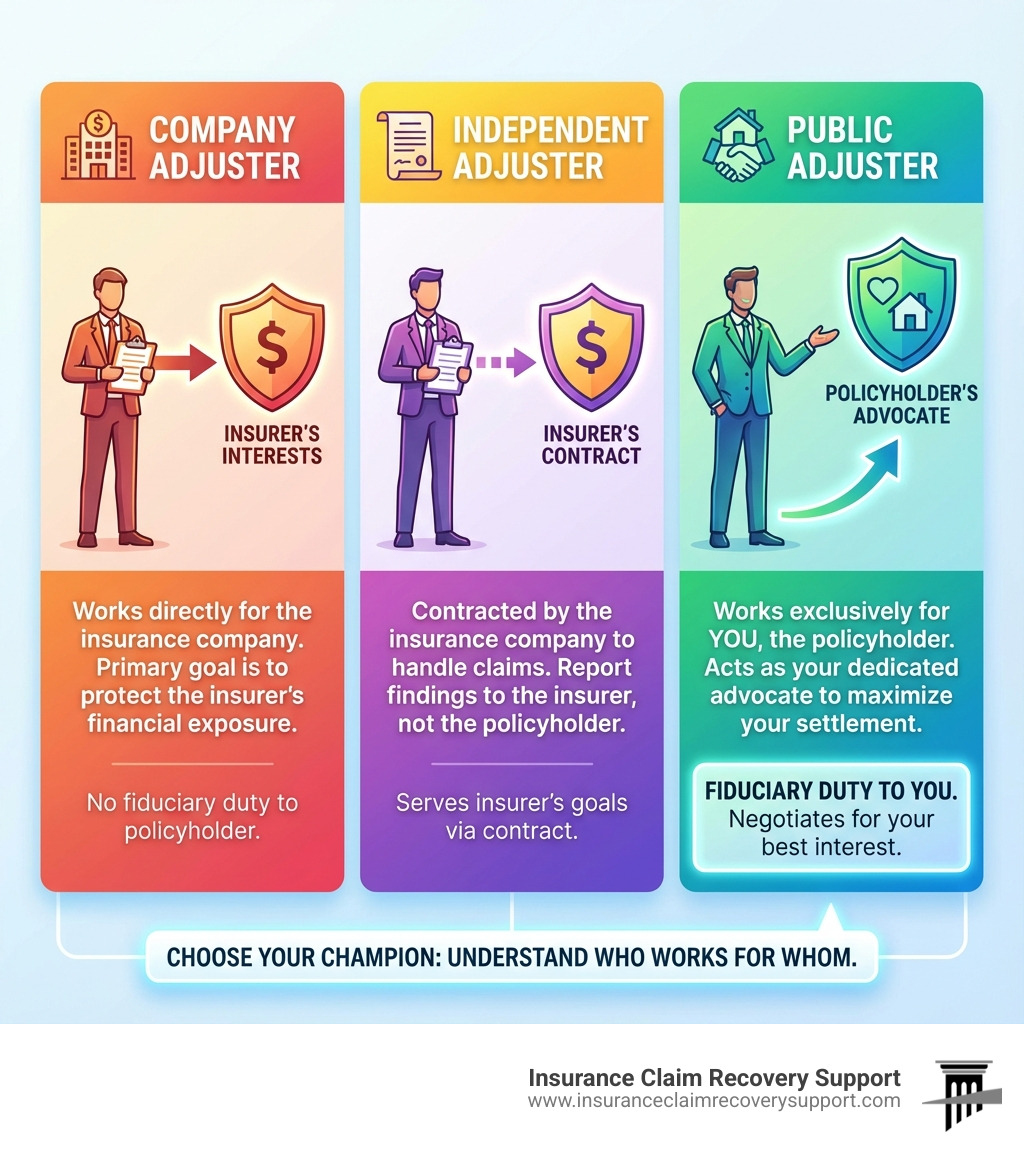
Understanding the different types of adjusters is the single most important factor in a successful claim outcome. When you file a claim, your insurance company will assign an adjuster to your case. This will either be a staff adjuster (a direct employee of the insurer) or an independent adjuster (an outside contractor hired by the insurer for a specific claim). In both scenarios, the adjuster works for and is paid by the insurance company. Their primary responsibility is to the insurer’s bottom line, and their goal is to determine the minimum amount the company is obligated to pay under the policy.
A licensed public adjuster, on the other hand, works exclusively for you, the policyholder. We have no affiliation with your insurance company. Our allegiance is solely to your financial recovery. This fundamental difference in representation is what truly levels the playing field and protects your interests.
Here’s a clear comparison:
| Feature | Public Adjuster | Company / Independent Adjuster |
|---|---|---|
| Allegiance | Works exclusively for you, the policyholder. | Works for the insurance company. |
| Primary Goal | To maximize your settlement and ensure a full recovery. | To minimize the insurance company’s payout. |
| Payment Source | Paid by you from a small percentage of the final settlement. | Paid a salary or fee by the insurance company. |
| Fiduciary Duty | Has a legal and ethical duty to act in your best interest. | Owes their duty and loyalty to the insurance company. |
This distinction is critical. The company adjuster’s assessment is not an unbiased, final determination of what you are owed; it is the opening position from a party with a conflicting interest. A public adjuster provides a professional counter-assessment that is focused entirely on your rights and losses. By carefully documenting every detail of the damage, accounting for business interruption, and citing specific policy provisions, a public adjuster builds a comprehensive claim that leaves no money on the table and compels the insurer to pay what is rightfully yours.