When Water Strikes: What San Antonio Property Owners Need to Know First
San Antonio water damage is one of the most urgent and costly challenges facing commercial property owners, multifamily operators, and hospitality managers in the region — and the clock starts ticking the moment water enters your building.
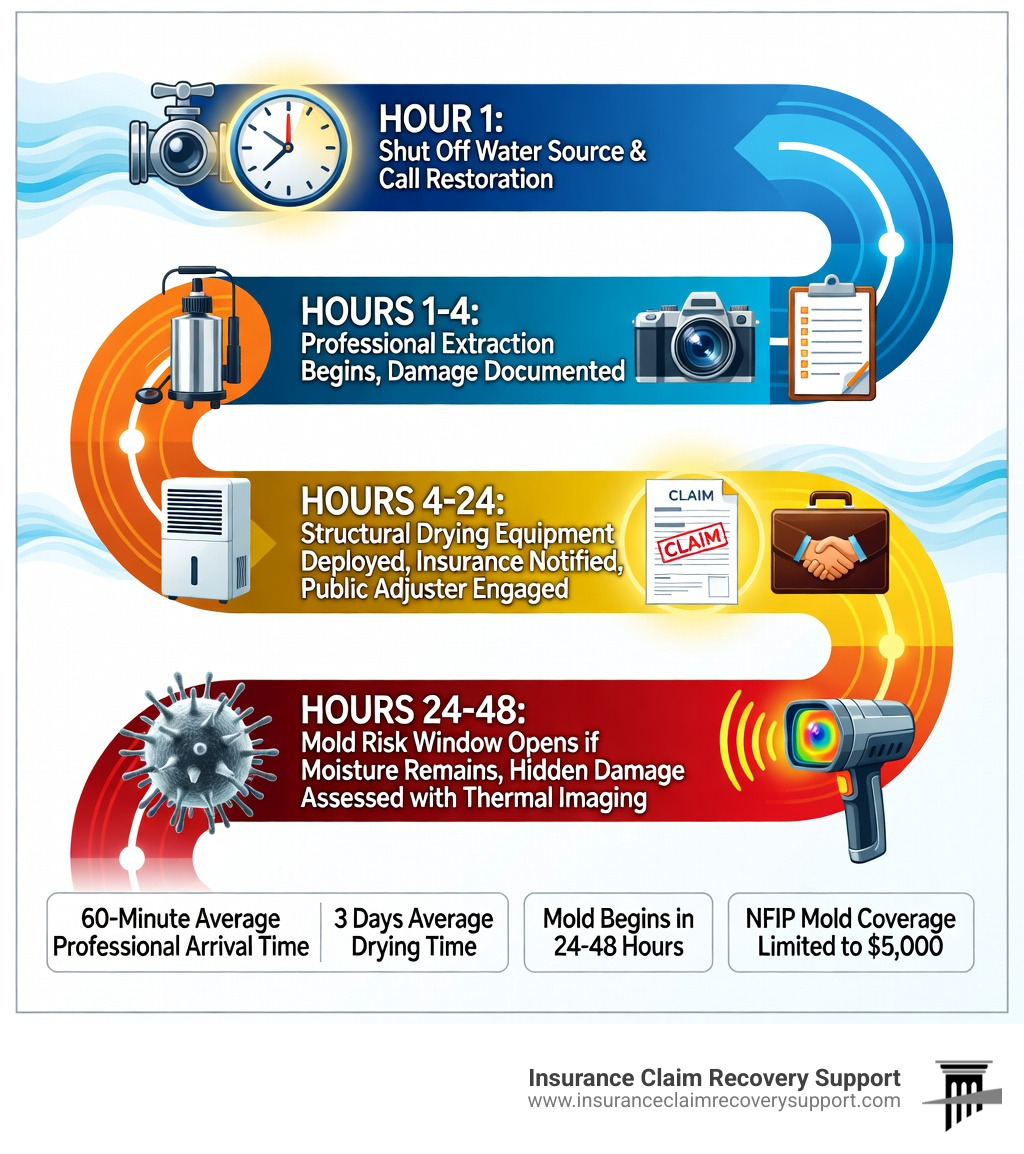
If you’re dealing with water damage right now, here’s what to do immediately:
- Stop the water source — shut off the main water valve or contact SAWS at 210-704-7297 for public line emergencies
- Document everything — photograph and video all visible damage before any cleanup begins
- Call a licensed restoration company — professional teams typically arrive within 60 minutes and begin extraction to prevent mold
- Notify your insurance carrier — then contact a public adjuster before signing anything or accepting a settlement
- Do not discard damaged property — insurers need to inspect materials to validate your claim
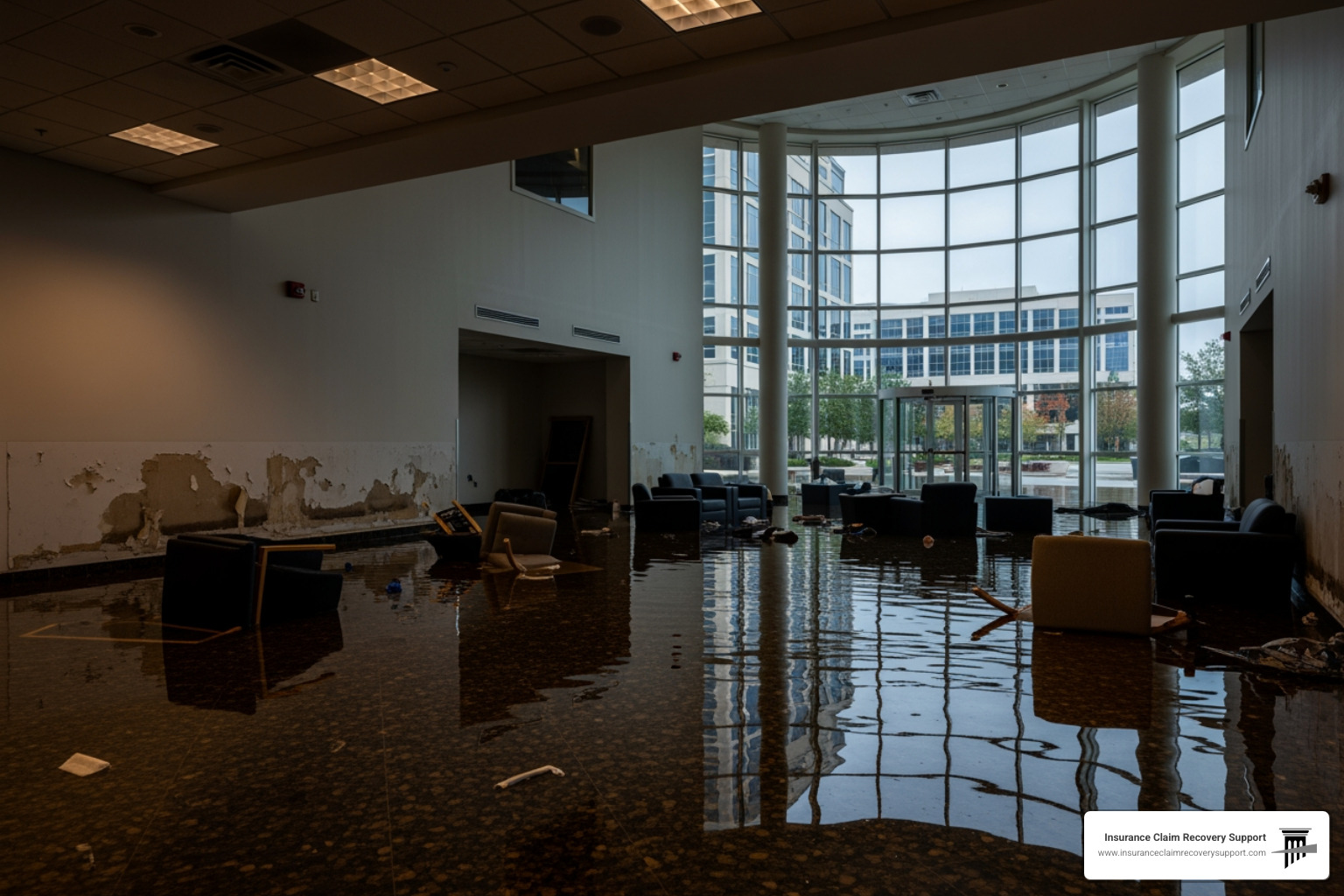
San Antonio sits in one of the most flood-prone regions in North America, and flash floods, burst pipes, and storm surges don’t wait for business hours. For commercial properties, even a few hours of standing water can mean structural damage, tenant displacement, and serious revenue loss — not to mention mold growth that can begin in as little as 24 to 48 hours.
What you do in the first 24 hours determines both the physical outcome and your insurance recovery. Most property owners focus entirely on the restoration side — and unknowingly leave significant claim value on the table.
That’s where understanding both sides of the equation matters.
I’m Scott Friedson, CEO of Insurance Claim Recovery Support (ICRS) and a multi-state licensed public adjuster with over 15 years of experience resolving large-loss San Antonio water damage claims for commercial and multifamily property owners. I’ve personally negotiated hundreds of millions in settlements, including cases where initial insurance offers were a fraction of what policyholders were rightfully owed — and in this guide, I’ll walk you through exactly how to protect your property and your claim.
Navigating San Antonio Water Damage: Causes, Categories, and Immediate Response
In Bexar County, the risk of water intrusion is a constant reality. Whether it’s a sudden cloudburst over the Hill Country or a mechanical failure in a high-rise HVAC system, San Antonio water damage requires a sophisticated response. We aren’t just talking about mopping up a spill; we are talking about the structural integrity of your investment.
To handle a loss effectively, we first have to identify what kind of water we are dealing with. The industry categorizes water into three types, and knowing the difference can save you from a massive health liability:
- Category 1 (Clean Water): This comes from a clean source, like a broken supply line or a leaking faucet. While it’s “clean” initially, it doesn’t stay that way. If left standing, it can quickly degrade into Category 2.
- Category 2 (Grey Water): This water contains significant contamination and has the potential to cause discomfort or sickness if consumed. Think washing machine overflows or dishwasher leaks.
- Category 3 (Black Water): This is the “big bad.” It is grossly unsanitary and contains pathogenic agents. Examples include sewage backups, rising floodwaters from rivers/streams, or any water that has been standing long enough to support microbial growth.
In San Antonio, many of our flood events involve Category 3 water because once rain hits the pavement and mixes with city runoff, it’s no longer clean. According to FEMA Flood Maps, many parts of our city are situated in high-risk zones where flash flooding can turn a parking lot into a lake in minutes.
The Role of SAWS and Reporting
If you suspect a leak is coming from the city’s infrastructure rather than your own plumbing, you need to act fast. The San Antonio Water System (SAWS) handles public service line leaks, but they cannot repair plumbing on private property. If you see water bubbling up from the street or a hydrant, call 210-704-SAWS (7297) immediately. For commercial managers, distinguishing between a city main break and a private line break is the first step in determining who is liable for the initial damage.
Advanced Detection: Seeing Through Walls
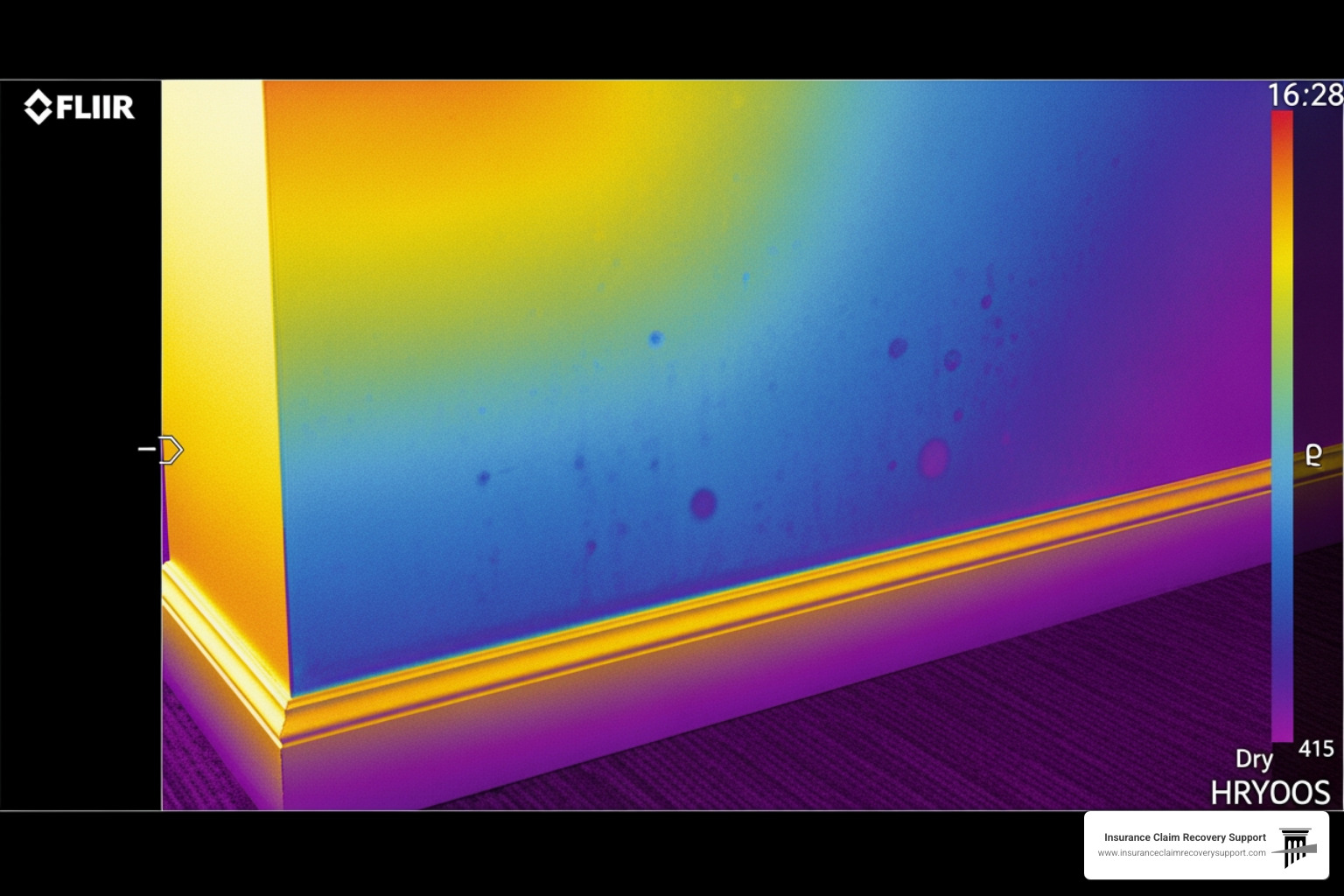
One of the biggest mistakes we see property owners make is assuming that if the carpet feels dry, the building is dry. We use advanced technology like FLIR thermal imaging and moisture mapping to find what the naked eye misses. Water often travels behind baseboards and saturates the “sill plate” of a wall. If that moisture isn’t detected and removed within 24 to 48 hours, mold growth is virtually guaranteed.
Common Causes of San Antonio Water Damage and Prevention
While we can’t control the weather, we can control how prepared we are for it. San Antonio’s climate is unique; we swing from extreme droughts to torrential Hill Country thunderstorms that overwhelm drainage systems.
1. Storm Season and Flash Floods San Antonio is often cited as one of the most flood-prone regions in North America. When the Edwards Aquifer recharges or the San Antonio River Authority dams reach capacity, the overflow has to go somewhere. For commercial buildings, this often means foundation seepage or roof failures during heavy wind-driven rain.
2. Frozen Pipe Bursts It sounds counterintuitive for South Texas, but we’ve all seen what happens when a deep freeze hits. Many San Antonio commercial buildings were not historically insulated for sustained sub-freezing temperatures. When those pipes thaw, they don’t just leak—they explode. We have handled numerous Freeze Damage Claims where a single Business Suffered Frozen Pipe Burst resulted in hundreds of thousands of dollars in damage across multiple floors.
3. HVAC and Mechanical Failures In a city where the AC runs ten months a year, HVAC condensation leaks are a leading cause of slow-burn San Antonio water damage. A clogged primary drain line can send gallons of water into ceiling tiles and wall cavities before anyone notices a drip.
Prevention Tips for Property Managers:
- Install Water Detection Devices: These smart sensors can be placed near water heaters, in mechanical rooms, and under sinks to alert your maintenance team the second moisture is detected.
- Clear Gutters and Downspouts: This is simple but critical. Ensure your roof drainage systems are clear before the spring storm season hits.
- Schedule Bi-Annual Inspections: Have a professional check your roof and plumbing twice a year. Detecting a small leak today prevents a catastrophic claim tomorrow.
Professional Restoration Standards and the San Antonio Water Damage Process
When you call a restoration company, you aren’t just hiring a cleaning crew—you’re hiring a technical team. In San Antonio, reputable companies should hold IICRC (Institute of Inspection Cleaning and Restoration Certification) and EPA Lead certifications.
The typical restoration process follows a strict protocol:
- Assessment: Using moisture meters and thermal cameras to map the “wet footprint.”
- Extraction: Removing standing water using industrial-grade truck-mounted pumps.
- Mitigation: This involves removing “unsalvageable” materials like saturated insulation or carpet pad. This is a critical step in Mitigation Fire and water loss scenarios to prevent secondary damage.
- Structural Drying: This is where the heavy lifting happens. Using high-velocity air movers and LGR (Low Grain Refrigerant) dehumidifiers.
- Monitoring: Technicians should return daily to check moisture levels in the air and the materials.
The 3-Day Rule: Most standard rooms take about three days to dry fully. However, advanced systems like ConvectionDrying® can accelerate this by 30% or more by using heated airflow to pull moisture out of dense materials like hardwood or concrete. This is a game-changer for commercial properties that need to minimize business interruption.
Maximizing Your Recovery: Insurance Claims vs. Litigation
Here is the hard truth: Your insurance company is a business, and their primary goal is to limit their financial exposure. When you file a claim for San Antonio water damage, the adjuster they send out works for them, not you.
We often see a massive gap between what a restoration company charges and what the insurance company wants to pay. Even more concerning is the “hidden damage” that insurance adjusters often overlook—moisture trapped under heavy machinery, inside elevator shafts, or deep within masonry.
The Public Adjuster Advantage
As public adjusters, we represent the policyholder exclusively. Our job is to find every cent of damage and ensure your settlement covers the actual cost of restoration and rebuilding.
Consider this real-world example: A residential burst pipe claim was initially settled for $450,000. The homeowner felt the amount was insufficient to cover the high-end finishes and structural repairs needed. After engaging a public adjuster to re-evaluate the hidden damage and policy coverages, the claim was settled for $910,000. That is the difference professional representation makes.
For more details on how these claims are structured, see our guide on Loss Types: Water Damage Insurance Claim.
Avoiding the “Lawsuit Trap”
Many property owners think that if the insurance company lowballs them, their only option is to sue. This is a myth. Litigation is slow, expensive, and often unnecessary. At Insurance Claim Recovery Support (ICRS), we have a 90% settlement success rate without the need for lawsuits. We use the “Appraisal” clause in most policies or simply provide such undeniable, tech-backed documentation that the carrier is forced to pay fairly.
Fact vs. Myth: Commercial Water Damage Claims
| Feature | Insurance Company Adjuster | Public Insurance Adjuster (ICRS) |
|---|---|---|
| Who they represent | The Insurance Company | You (The Policyholder) |
| Primary Goal | Minimize the payout | Maximize the settlement |
| Damage Assessment | Often looks for reasons to deny coverage | Looks for all visible and hidden damage |
| Cost to You | Paid by the insurance company | Percentage of the settlement (No upfront cost) |
| Expertise | Generalist | Specialist in large-loss commercial claims |
Myth: My insurance agent will handle the claim for me. Fact: Your agent sells policies; they do not adjust claims. Once a loss occurs, the claim is handed off to a different department whose job is to “manage” the loss (often by reducing costs).
Myth: I have to use the restoration company the insurance company recommends. Fact: You have the right to choose your own contractors. Often, “preferred vendors” for insurance companies have pre-negotiated rates that may lead to “cutting corners” to stay within the carrier’s budget.
Myth: My flood policy covers everything. Fact: If you have an NFIP (National Flood Insurance Program) policy, be aware that there is usually a 30-day waiting period before it becomes active. Furthermore, NFIP policies often have a strict $5,000 limit on mold remediation, regardless of the total damage. If you don’t dry your building out fast enough, you could be stuck with a massive out-of-pocket bill.
Frequently Asked Questions for San Antonio Property Managers
Q: How long does the restoration process typically take? A: For a standard commercial office suite, the drying phase is usually 3-5 days. However, the full reconstruction and insurance settlement process can take weeks or months depending on the scale. Engaging a public adjuster early can significantly reduce these delays.
Q: Does my policy cover “Business Interruption”? A: Most commercial policies do, but calculating it is complex. You have to prove the income you would have made if the water damage hadn’t occurred. We specialize in documenting these losses to ensure you aren’t just paid for bricks and mortar, but for your lost time and revenue.
Q: What if the mold has already started? A: According to the CDC Mold Health Effects, mold can cause serious respiratory issues and skin irritation. If mold is present, you must use a certified mold remediation specialist who follows state-mandated protocols (which in Texas are quite strict for commercial properties).
Q: Is the property owner responsible for the sidewalk or street leaks? A: Generally, SAWS is responsible for the main lines and the meter. Anything from the meter to the building is the property owner’s responsibility. If a city main breaks and floods your basement, you may have a claim against the city, but these are notoriously difficult to navigate without professional help.
Why Commercial Owners Choose Public Adjusters Over Lawsuits
At the end of the day, property managers and owners want two things: their building back and their claim paid.
Lawsuits can drag on for years, leaving your property in a state of disrepair and your tenants frustrated. Our approach at Insurance Claim Recovery Support (ICRS) is different. We focus on:
- Reducing Delays: We know the “stalling tactics” carriers use and how to bypass them.
- Expert Documentation: We provide the Matterport 3D scans, thermal images, and Xactimate estimates that insurance companies can’t ignore.
- Policy Advocacy: We find the coverages your carrier might “forget” to mention, like code upgrades or debris removal.
We advocate for professional property managers, apartment investors, HOAs, and hospitality groups across San Antonio. Our goal is to settle your claim for the maximum amount as quickly as possible, allowing you to focus on your business while we handle the insurance headache.
If your property has suffered significant damage, don’t settle for the first check the insurance company cuts. Get a second opinion from a team that only answers to you.