Why Claims Adjuster Classes Are Your Gateway to a Rewarding Career
Claims adjuster classes are specialized training programs that prepare you to evaluate, investigate, and settle insurance claims—a critical role in the property insurance industry. Whether you’re considering a career change or looking to enter the insurance field, understanding your training options is essential.
Quick Overview: What You Need to Know About Claims Adjuster Classes
Entry Requirements:
- High school diploma or equivalent
- 18+ years of age
- Clean background check (varies by state)
Typical Course Duration:
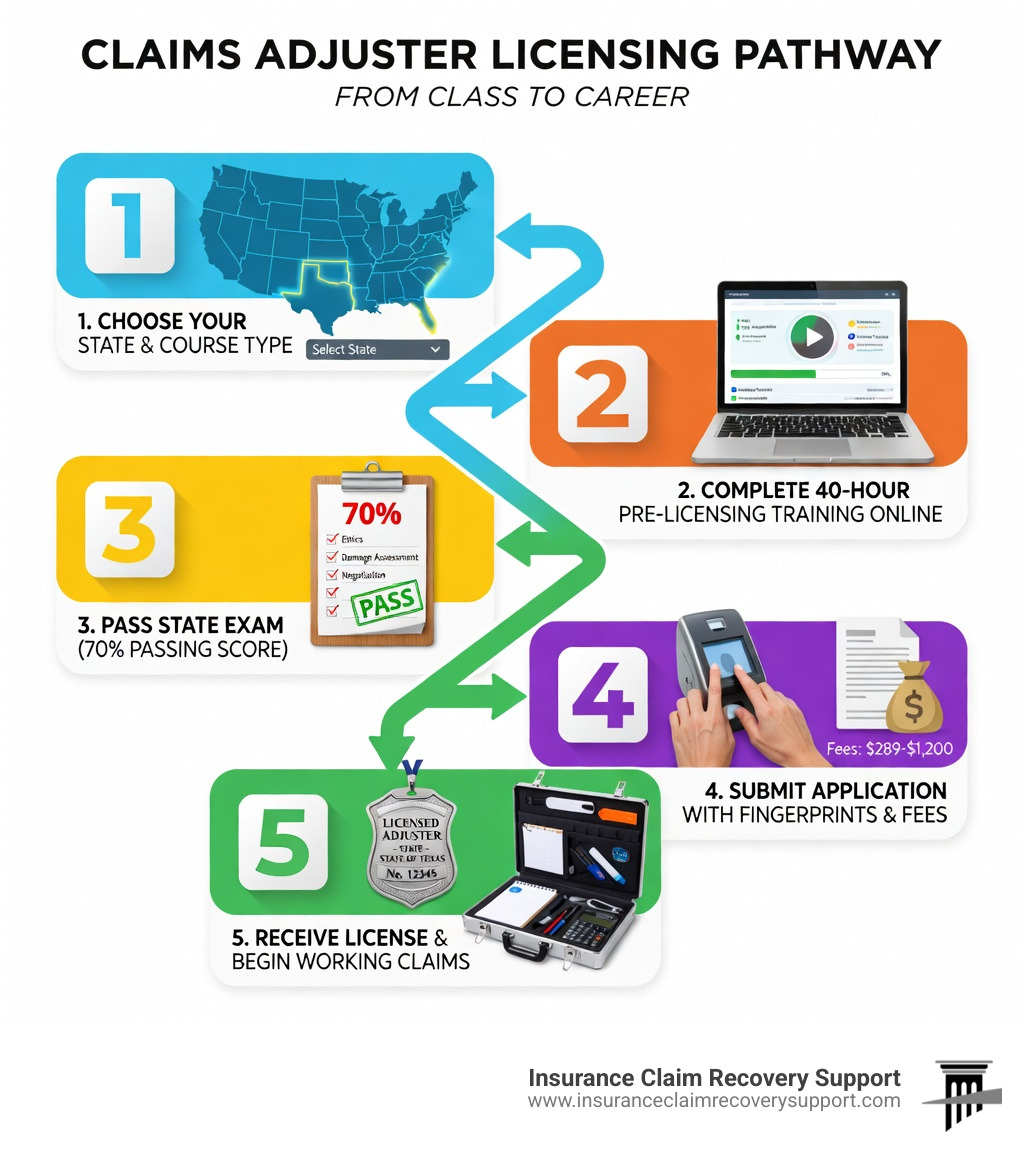
- 40 hours for pre-licensing courses
- Self-paced online options available
- 1-4 weeks to complete
Average Costs:
- Course fees: $169-$979
- State exam: $50-$79
- Total licensing: $289-$1,200 (including fingerprints, bonds, and fees)
Popular License Types:
- Texas All-Lines Adjuster (reciprocal in 30 states)
- Florida CALA (Designated Home State license)
- California Independent Adjuster
- State-specific licenses
The insurance claims industry employs over 356,000 professionals nationwide, with a median annual salary of $76,790 according to the Bureau of Labor Statistics. While some states require formal licensing and examinations, others allow adjusters to work under Designated Home State (DHS) exemptions. Most training providers offer 100% online, self-paced courses that cover essential topics like policy interpretation, damage assessment, ethics, negotiation, and industry-standard software such as Xactimate. After completing your coursework and passing the state exam, you’ll be qualified to work as an independent contractor during catastrophes, join an insurance carrier as a staff adjuster, or pursue specialized roles in property or commercial claims.
The path you choose depends on your career goals, geographic location, and whether you want to represent insurance companies or policyholders. Independent adjusters typically handle catastrophe claims for multiple carriers, while staff adjusters work directly for insurance companies with salaried positions. Public adjusters, on the other hand, exclusively represent property owners—advocating for maximum settlements and helping avoid costly litigation when claims are underpaid or wrongfully denied.
I’m Scott Friedson, and over 15 years I’ve settled hundreds of millions in large-loss property damage claims for commercial and multifamily property owners. While my experience has been on the policyholder advocacy side, I’ve worked extensively with adjusters trained through claims adjuster classes and understand what makes effective training programs stand out.
Choosing the Right Claims Adjuster Classes for Your Career
Choosing the right path starts with understanding your end goal. Do you want to work for a big insurance carrier, travel the country as an independent contractor after a major hurricane, or advocate for the “little guy” (or the “big commercial guy”) as a public adjuster?

When you begin looking at claims adjuster classes, you’ll find two main formats: pre-licensing and exam prep. Pre-licensing courses are often state-mandated (like the 40-hour requirement in Texas) and fulfill the educational hours needed to sit for the exam. Exam prep courses, however, are like the “cliff notes” on steroids—designed specifically to help you pass that 150-question state exam on the first try.
Most modern students prefer online, self-paced training. Why? Because you can study at 2:00 AM in your pajamas if that’s when your brain works best. These programs are often mobile-friendly, allowing you to squeeze in a lesson on policy exclusions while waiting for your coffee.
For those looking to dive deeper into the curriculum, you can find More info about adjuster courses to see how these programs are structured.
To help you decide which career path fits your personality, here is a quick comparison:
Comparison of Adjuster Roles
| Feature | Staff Adjuster | Independent Adjuster | Public Adjuster |
|---|---|---|---|
| Employer | Insurance Company | Independent Adjusting Firm | Policyholder (You!) |
| Representation | Represents the Carrier | Represents the Carrier | Represents the Property Owner |
| Salary/Pay | Salaried + Benefits | Fee Schedule / Per Claim | Percentage of Settlement |
| Workload | Steady, consistent | High volume during storms | High-stakes, specialized |
| Training Needs | In-house + Licensing | Licensing + Software Certs | Licensing + Deep Policy Expertise |
Essential Topics and Software in Claims Adjuster Classes
If you think claims adjuster classes are just about reading boring insurance policies, think again! While policy language is the foundation, a modern adjuster needs to be part detective, part mathematician, and part diplomat.
Key topics covered in high-quality training include:
- Xactimate Training: This is the industry-standard software for estimating building damage. If you don’t know Xactimate, you’re essentially trying to write a novel without knowing how to use a keyboard.
- Damage Assessment: Learning the difference between “functional damage” and “cosmetic damage”—and why that distinction matters for a commercial roof after a hail storm.
- Construction Math: Calculating square footage, waste factors, and depreciation. (Yes, you finally have to use the math you learned in high school!)
- Ethics and Negotiation: How to stay professional when tensions are high and how to negotiate a fair settlement based on facts, not feelings.
- Investigation: Interviewing witnesses and claimants to determine the validity of a claim.
According to the Scientific research on claims adjuster employment data, the ability to accurately estimate costs and negotiate agreements is what separates the top earners from the rest.
Texas All-Lines and Reciprocity in Claims Adjuster Classes
If you live in a state that doesn’t require a license—or if you want the most powerful license in the industry—you need to look at the Texas All-Lines Adjuster License.
Texas is widely considered the gold standard for adjuster licensing. Why? Reciprocity. A Texas All-Lines license is reciprocal in 30 other states. This means once you have your Texas license, you can apply for licenses in states like Oklahoma, Georgia, or Indiana just by paying a fee—no extra exams required.
For those living in “non-licensing” states (like Colorado or Kansas), you can designate Texas as your “Home State” (DHS). This gives you the professional credibility you need to handle claims across state lines. We often see professionals start as an Independent Home Insurance Adjuster before moving into the high-stakes world of commercial property claims.
Licensing Requirements and Costs for Key States
While we love the Texas license, every state has its quirks. Here’s a breakdown of what you might expect in our primary service areas:
- Texas: Requires a 40-hour course and a 150-question exam. Total cost is roughly $289, which includes the course, application fee, and fingerprinting.
- Florida: Offers the “CALA” (Certified Accredited Lines Adjuster) designation. Florida is a massive market for hurricane claims, making this license highly valuable.
- California: California is the “Final Boss” of licensing. They require two years (4,000 hours) of certified experience in insurance adjusting before you can even apply for an independent adjuster license. They also require a $2,000 surety bond.
- Georgia: Requires a $5,000 counselor bond and a $120 licensing fee.
On average, you should budget between $300 and $1,000 to get fully licensed and “field-ready.” It’s a small investment for a career with a median salary of over $76,000.
Comparing Independent, Staff, and Public Adjuster Roles
In our work at Insurance Claim Recovery Support (ICRS), we interact with all three types of adjusters. It’s important to understand whose team everyone is on.
Staff Adjusters are the “home team” for the insurance company. They are salaried employees. Their job is to settle claims according to company guidelines. They usually enter the process within 24 to 48 hours of a loss.
Independent Adjusters (IAs) are like “hired guns.” When a massive tornado hits Dallas or a hurricane slams into Houston, insurance companies don’t have enough staff to handle the volume. They hire IA firms to fill the gap. While they are independent contractors, they still represent the insurance company’s interests. If you’re interested in this path, you can learn how to Become an Independent Insurance Adjuster.
Public Adjusters (PAs)—that’s us! We are the only adjusters licensed to represent the policyholder exclusively. We don’t work for the insurance company; we work for commercial building owners, HOAs, and apartment investors. Our goal is to ensure the settlement is maximized and that the insurance company doesn’t “miss” any covered damage.
Public Adjusters vs. Litigation: Maximizing Commercial Settlements
For commercial property owners in cities like Austin, San Antonio, or Fort Worth, a large-loss claim (like a fire or major windstorm) can be a nightmare. The insurance company’s adjuster might offer a settlement that barely covers the roof, let alone the business interruption or interior water damage.
This is where the choice between a Public Adjuster and an attorney becomes critical.
Fact vs. Myth: The Litigation Trap
- Myth: “I need to sue my insurance company to get a fair payout.”
- Fact: Litigation is slow, expensive, and often unnecessary. Most commercial claims can be resolved through professional public adjusting and the appraisal process.
At ICRS, we have a 90% settlement success rate without the need for lawsuits. Litigation can take years and eat up 30-40% of your settlement in legal fees. By using a public adjuster who understands the “language” of the insurance company’s adjusters (thanks to those same claims adjuster classes), we can often resolve claims in months, not years.
We advocate for multifamily operators and professional property managers to avoid the “litigation roadmap” that carriers often hope you’ll take, as it delays their need to pay out.
Salary Outlook and Continuing Education Requirements
The financial outlook for this career is strong. With a median annual wage of $76,790, it’s a lucrative field for those who are detail-oriented. While the national job outlook shows a slight 5% decline due to automation, the demand for human adjusters in complex commercial and catastrophe claims remains high. In Florida, for example, employment for adjusters is projected to grow by 6% through 2032.
Once you have your license, the learning doesn’t stop. Most states, including Texas and California, require 24 hours of Continuing Education (CE) every two years. This must include at least 3 hours of ethics.
Continuing education ensures you stay up-to-date on new legislation, such as changes in Texas fire and storm damage laws or local insurance claim timelines. It’s not just about keeping your license; it’s about maintaining your edge in a competitive market.
Conclusion: Advancing Your Career in Large-Loss Advocacy
Whether you are just starting your journey by looking into claims adjuster classes or you are a property owner trying to understand who is knocking on your door after a storm, education is power.
For aspiring adjusters, this career offers a unique blend of office work and field exploration, with the opportunity to help people rebuild their lives after a disaster. For commercial building owners in Houston, Lubbock, or Waco, understanding the training your adjuster has received helps you ask the right questions during the claim process.
If you’re a commercial property owner or multifamily manager dealing with a complex claim, you don’t have to settle for the first offer. We specialize in maximizing settlements and reducing delays for large-loss claims involving fire, hail, hurricanes, and more. Our expertise allows us to resolve disputes fairly and avoid the headaches of unnecessary litigation.
Ready to take the next step in your professional journey? You can find More info about adjuster training schools to jumpstart your career or gain a deeper understanding of the industry.
In insurance, the right training makes all the difference. Whether you’re the one adjusting the claim or the one receiving the settlement, knowing the rules of the game ensures that everyone is treated fairly and that properties are restored to their pre-loss condition. Stay educated, stay licensed, and always advocate for the truth in every claim.